alliums ameraucana Anthony Bourdain aphids Appleseed Permaculture aquaponics arthritis artichokes Asian Vegetables aussie basil baby chicks baby turnips bearss lime bee keeping beet greens beneficial insects benner tree farm Biochar Bitter Melon blight blooming hill farm boothby blonde cucumber brix broccoli brussels sprouts cabbage cabbage hill farm camp hill farm cancer caraflex celeriac chicken coop chickens children chinese tamale chives cilantro cilantro root coconut cold frames collard greens Compost coriander corn crop rotation cruciferous crucifers cucumber Dan Barber dan kittredge Dave Llewellyn detox dirty dozen dragon fruit Dutch white clover dwarf citrus eggplant Elderberries factory farms farm to table farmer's market farmers markets Fava beans ffarm to table fish oil flea beetle flowers food allergies food combining food miles founding farmers four wind growers Fred Kirschenmann french bulldog G6pd deficiency garlic garlic festival garlic scapes geese Glynwood grass-fed beef Great Outdoors Listening Tour green tomatoes greenhouse growing indoors Hanalei Hemlock Hill Farm heritage turkey heritage USA hudson valley farms hurricane Irene hyssop iced tea infections influenza Insect control isothiocyanates joan gussow jolie lampkin joong kaffir lime kale Kauai kohlrabi korean licorice mint Ladybugs late blight leeks lettuces local food locust tree maine avenue fish market menhaden meyer lemon mycelia mycorrhizal natural fertilizers nectary nightshades No Reservations Nurse cropping nutrient density okra organic Baby food organic christmas tree Organic Pest Control Parsley Paul tappenden peas Permaculture pesticides pesto petite watermelon plant sap pH plymouth barred rock pole beans potatoes preserving food purple basil qunice Radish Greens rainbeau ridge farm raised beds rampicante raw food real food campaign red hook Rockland Farm Alliance ronnybrook farm row covers salt-preserved duck eggs sambucus nigra seed saving seedlings Sheet mulching small space soil analysis soil blocks soil conductivity sorrel Squash Vine Borer star fruit sugar snap peas sustainability sustainable fishing Swiss Chard tabbouleh TEDx Manhattan terracing three sisters tomato sauce tomatoes trellis trovita orange turkana farms Tuttle Farm urban zen volt white clover winter harvest Winter Squash Young Farmers Conference
Indispensable Books and Resources
  • Edible Forest Gardens (2 volume set)
    Edible Forest Gardens (2 volume set)
    by Dave Jacke, Eric Toensmeier
  • The Winter Harvest Handbook: Year Round Vegetable Production Using Deep Organic Techniques and Unheated Greenhouses
    The Winter Harvest Handbook: Year Round Vegetable Production Using Deep Organic Techniques and Unheated Greenhouses
    by Eliot Coleman
  • The Biological Farmer: A Complete Guide to the Sustainable & Profitable Biological System of Farming
    The Biological Farmer: A Complete Guide to the Sustainable & Profitable Biological System of Farming
    by Gary F. Zimmer
  • The Garden Primer: Second Edition
    The Garden Primer: Second Edition
    by Barbara Damrosch
  • 1500 Live LadyBugs - A GOOD BUG! - Lady Bug
    1500 Live LadyBugs - A GOOD BUG! - Lady Bug
    Organic Insect Control
  • Acres U.S.A.
    Acres U.S.A.
    Acres U.S.A.

    The best farming and growing magazine money can buy!

  • Seed Starter Soil Block Maker Makes 4 Medium Blocks
    Seed Starter Soil Block Maker Makes 4 Medium Blocks

    2" Soil Blocker

  • Mini Soil Blocker
    Mini Soil Blocker
  • New York City Farmer & Feast: Harvesting Local Bounty
    New York City Farmer & Feast: Harvesting Local Bounty
    by Emily Brooks
  • What Doctors Eat: Tips, Recipes, and the Ultimate Eating Plan for Lasting Weight Loss and Perfect Health
    What Doctors Eat: Tips, Recipes, and the Ultimate Eating Plan for Lasting Weight Loss and Perfect Health
    by Tasneem Bhatia, Editors of Prevention


THE DAILY BROADFORK

Short journal entries detailing the nuts and bolts of our ventures in growing food at our micro-farm

Entries in Companion Planting (2)

Thursday
Jul142011

Intern's Corner: A Small Space Experiment - Planting The Three Sisters

Alison Siggelko, one of our departing interns spent a full spring with us getting things in the ground and helping us immensely at the farmer's market.  We bid her a fond adieu as she heads to California for graduate school in Transpersonal Psychology.  Good luck Alison!  You will be missed!

The Three Sisters growing technique is a Native American way of companion planting with squash, corn and pole beans.  Typically you need at least a 10' x 10' space but we had a lot less to work with.  This is our experiement:
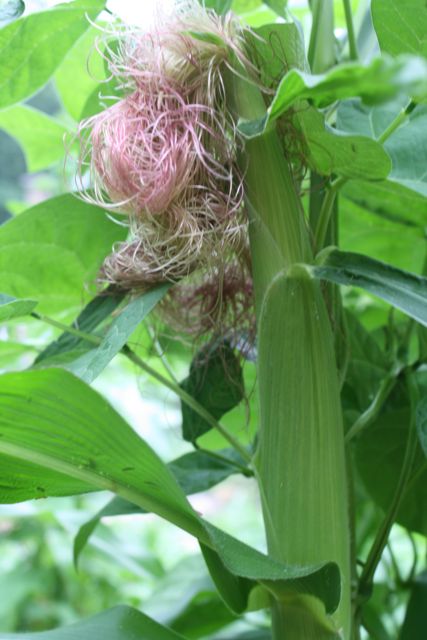
 

The first ear of corn. Not the cornsilk which you can make a tea from helpful in bladder infectionsA few weeks ago, the interns were asked to plant a Three Sisters garden. With free reign to designate planting mounds and seed spacing, we were initially nervous. Between a combination of how-to planting guides and the ancient myth of Three Sisters, we figured out how to lay four soil mounds and plant our first crop of corn.

    I personally remember the legend of the Three Sisters from elementary school. Corn, beans and squash were the first crops to become domesticated by Mesoamericans and were viewed with great reverence as gifts from the Great Spirit. (The legend of the Three Sisters can be found here.) What was left out of my brief education of the Three Sisters was the sustainable science of this growing method.

    Once our corn began to sprout, we planted pole beans around each corn plant. The corn stalk will provide a trellis for the beans to climb, and the bean's presence will not only stabilize the tall corn, but will also fix the nitrogen in the soil for the corn of following years. Squash* was planted around the corn/bean mounds providing soil cover and eventually crop residue beneficial for soil structure.
    Nutritionally the combination of the three plants is also well balanced. Corn provides carbs, beans give us protein and a balance to the amino acid found in corn, and squash fruit is chock full of vitamins.
     Of course, ancient Americans didn't understand the chemistry behind this system. In all probability, they discovered Three Sisters because these crops could be successfully cultivated while maintaining balance and health for people. It is a beautiful example of common-sense sustainability and a reminder of the importance of maintaining indigenous traditions.
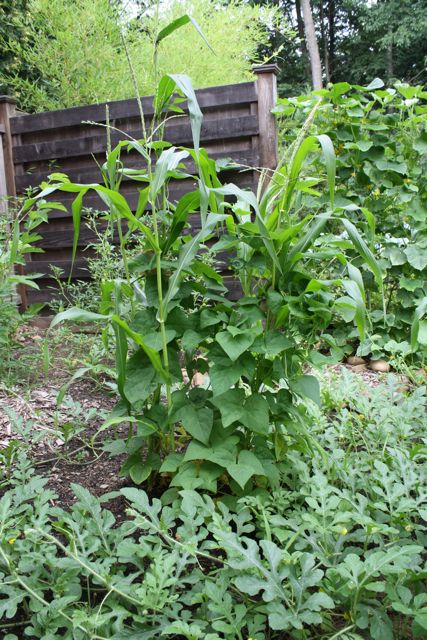


Corn providing the trellis for the climbing beans and watermelon as groundcover to suppress the weedsThough none of the interns follow Native traditions, I think it’s safe to say we all felt a shimmer of the ceremonial as we built our soil mounds and planted corn seeds. In keeping with indigenous tradition we decided that there should be four mounds and that they should each represent one of the four directions (N,S,E,W). Though we giggled at our unexpected reverence for tradition, I for one felt a surprising satisfaction at combining the practicalities of farming with a respect and admiration of nature.


Alison

* Instead of squash, petite watermelon were planted since vine borers had been a problem in the previous year in the same location.
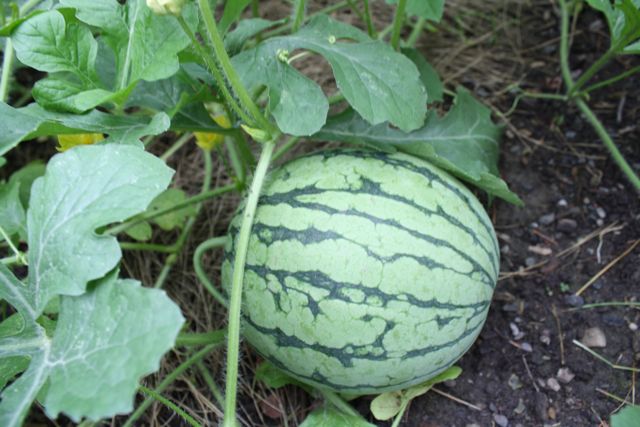
 Our first trial at watermelon. Everytime I see this guy it makes me happy.
Tuesday
Apr122011

Fava Beans: Benefits of Pre-sprouting, Nurse Cropping and Companion Planting

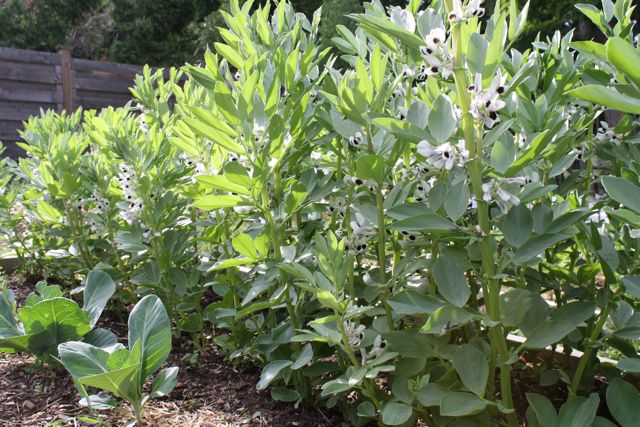
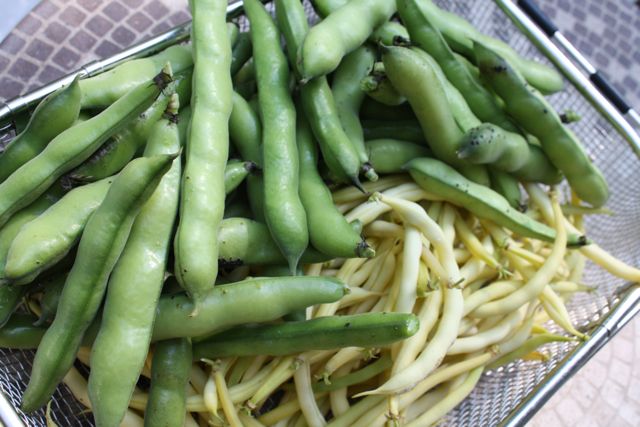
Last year's harvest of fava and yellow wax beansFava Beans, or broad beans as they are known in the UK, are the ubiquitous spring crop at farmer's markets.  Actually, they really show up in late May or June.  Here, at HMG, they are just being planted.  As a crop, they don't yield much when you take into account their spacing and the final weight before it makes it into your mouth.  Somewhat labor intensive, you have to remove both the thick pods and also the skins of the larger beans.  So a pound of beans gives you about a cup to a cup and a half of usable product. It is worth it?  Yes!  The taste, in my opinion, is sublime.  One of my favorite things to make is a fava bean and mint puree or just lightly steamed favas sauteed in a little butter with a light grating of parmesan cheese.  Of medicinal interest, favas may be helpful for those with Parkinson's disease as the bean, leaves and roots contain naturally occuring levo-dopamine, the medicine that is used to treat Parkinson's disease.  Also, individuals with G6PD deficiency (usually of Mediterranean descent) will develop a hemolytic anemia (lysis of red blood cells) if favas are consumed.

GROWING.  Direct seeding vs Sprouting

Planting these are easy.  You can directly seed these whopper-sized seeds and they germinate quickly.  I started them in 2" soil blocks weeks ago in hopes of getting an earlier crop.  They do root vigorously in soil blocks so don't wait too long to plant them out.  They are sown 6-8" apart in rows 18-36" apart.  Being greedy for space, I decided this year to be more bio-intensive about the planting and used John Jeavon's  guide to every 8" with smaller rows.  As they grow, there are a few issues to look out for.  The stems will need a light support, whether it be small bamboo stakes or creating a nest of twigs around the plants and rows.  Watch out for the black bean aphid or blackfly.  You can reduce the problem by pinching out the top 4" when the plant is in full flower and your first bean is forming at the base.  Don't throw these away; they can be lightly cooked and thrown into a pasta dish.  This is "nose-to-tail" growing!
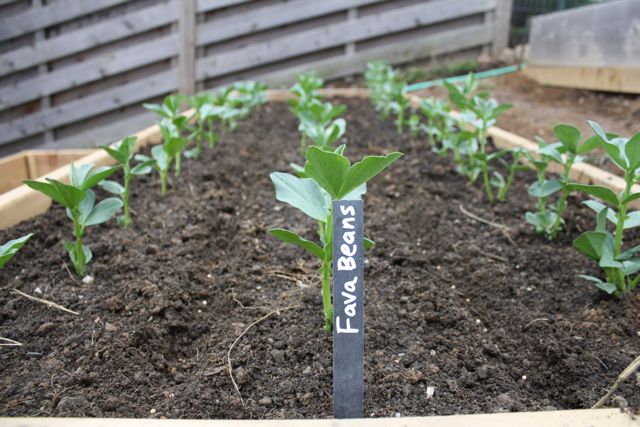
 Pre-sprouted favas planted and cilantro directly seeded in between.

COMPANION PLANTING AND NURSE CROPPING

Companion planting is a method of plant grouping so that each plant benefits from the proximity of the other.  Supposedly tomatoes are helped by basil and strawberries by borage, for example.  Conversely, there are things that should not be planted together, most notably fennel.  Supposedly nothing grows well when planted next to fennel.  From what I can tell, much of this is anecdotal through the collective decades of growing and observations people have made.  It would be interesting to see some science behind this.  It is rumoured that fava's enjoy the company of the herb savory and eggplant.  However, it is many weeks before I put eggplant in the ground and savory is nicely situated in the perennial herb area.  So I'm going to take a gamble and plant cilantro in between.  I am sick and tired of purchasing cilantro only to see it quickly go brown in the fridge days later.  It is an herb I use all the time and finding areas that I can succession grow these is sparse in a bio-intensive mini-farm.  This will be an experiment and I'll be sure to report back.

 Last year, I planted cabbage as a companion plant to favas.

Nurse cropping is another version of companion planting where by you can quickly grow a crop in an unused area next to another crop that has a longer growing cycle.  I do this with broccoli and lettuce.  By the time broccoli gets large enough, the lettuce below will benefit from the shading of the large waxy leaves.  This extends the growing season of lettuce and prevents bolting.  It's just another way of space efficiency and symbiosis.  Fava beans can be a nurse crop for potatoes.  As a legume, they'll fix nitrogen into the soil for the enlarging and hungry potato crop and they will be conveniently harvested well before the potato leaves take over in growth.  We'll also try this method for the first time this year and see what happens!


Hungry for a recipe?  Check out our friends at Grapes and Greens.  Deborah Soffel created this recipe of Artichoke Hearts, Spinach and Fava Beans Braised in White Wine that I hope to try once fava beans are ready in our farm.  Or maybe Hannibal Lecter's favorite: liver, fava beans and a nice chianti...