alliums ameraucana Anthony Bourdain aphids Appleseed Permaculture aquaponics arthritis artichokes Asian Vegetables aussie basil baby chicks baby turnips bearss lime bee keeping beet greens beneficial insects benner tree farm Biochar Bitter Melon blight blooming hill farm boothby blonde cucumber brix broccoli brussels sprouts cabbage cabbage hill farm camp hill farm cancer caraflex celeriac chicken coop chickens children chinese tamale chives cilantro cilantro root coconut cold frames collard greens Compost coriander corn crop rotation cruciferous crucifers cucumber Dan Barber dan kittredge Dave Llewellyn detox dirty dozen dragon fruit Dutch white clover dwarf citrus eggplant Elderberries factory farms farm to table farmer's market farmers markets Fava beans ffarm to table fish oil flea beetle flowers food allergies food combining food miles founding farmers four wind growers Fred Kirschenmann french bulldog G6pd deficiency garlic garlic festival garlic scapes geese Glynwood grass-fed beef Great Outdoors Listening Tour green tomatoes greenhouse growing indoors Hanalei Hemlock Hill Farm heritage turkey heritage USA hudson valley farms hurricane Irene hyssop iced tea infections influenza Insect control isothiocyanates joan gussow jolie lampkin joong kaffir lime kale Kauai kohlrabi korean licorice mint Ladybugs late blight leeks lettuces local food locust tree maine avenue fish market menhaden meyer lemon mycelia mycorrhizal natural fertilizers nectary nightshades No Reservations Nurse cropping nutrient density okra organic Baby food organic christmas tree Organic Pest Control Parsley Paul tappenden peas Permaculture pesticides pesto petite watermelon plant sap pH plymouth barred rock pole beans potatoes preserving food purple basil qunice Radish Greens rainbeau ridge farm raised beds rampicante raw food real food campaign red hook Rockland Farm Alliance ronnybrook farm row covers salt-preserved duck eggs sambucus nigra seed saving seedlings Sheet mulching small space soil analysis soil blocks soil conductivity sorrel Squash Vine Borer star fruit sugar snap peas sustainability sustainable fishing Swiss Chard tabbouleh TEDx Manhattan terracing three sisters tomato sauce tomatoes trellis trovita orange turkana farms Tuttle Farm urban zen volt white clover winter harvest Winter Squash Young Farmers Conference
Indispensable Books and Resources
  • Edible Forest Gardens (2 volume set)
    Edible Forest Gardens (2 volume set)
    by Dave Jacke, Eric Toensmeier
  • The Winter Harvest Handbook: Year Round Vegetable Production Using Deep Organic Techniques and Unheated Greenhouses
    The Winter Harvest Handbook: Year Round Vegetable Production Using Deep Organic Techniques and Unheated Greenhouses
    by Eliot Coleman
  • The Biological Farmer: A Complete Guide to the Sustainable & Profitable Biological System of Farming
    The Biological Farmer: A Complete Guide to the Sustainable & Profitable Biological System of Farming
    by Gary F. Zimmer
  • The Garden Primer: Second Edition
    The Garden Primer: Second Edition
    by Barbara Damrosch
  • 1500 Live LadyBugs - A GOOD BUG! - Lady Bug
    1500 Live LadyBugs - A GOOD BUG! - Lady Bug
    Organic Insect Control
  • Acres U.S.A.
    Acres U.S.A.
    Acres U.S.A.

    The best farming and growing magazine money can buy!

  • Seed Starter Soil Block Maker Makes 4 Medium Blocks
    Seed Starter Soil Block Maker Makes 4 Medium Blocks

    2" Soil Blocker

  • Mini Soil Blocker
    Mini Soil Blocker
  • New York City Farmer & Feast: Harvesting Local Bounty
    New York City Farmer & Feast: Harvesting Local Bounty
    by Emily Brooks
  • What Doctors Eat: Tips, Recipes, and the Ultimate Eating Plan for Lasting Weight Loss and Perfect Health
    What Doctors Eat: Tips, Recipes, and the Ultimate Eating Plan for Lasting Weight Loss and Perfect Health
    by Tasneem Bhatia, Editors of Prevention


THE DAILY BROADFORK

Short journal entries detailing the nuts and bolts of our ventures in growing food at our micro-farm

Entries in Four Season Growing (2)

Thursday
Nov032011

What Survives After a Freak Snow Storm in October? 

The lamenting continues about how this season was one of the worst growing seasons in Northeast coast memory.  Yes, the incessant flooding rains, then hurricane Irene in September and last weekend, we had 10-12" of snow before Halloween.  What's next?  Doesn't quite matter since the damage is done.  We've typically harvested until the end of November.  Thanks to our buddies at Nazunya Designs we were able to have our high tunnel up and operational 16 hours before the storm hit. The high tunnel protects our 4 main beds that will enable us to grow our lettuces, mustard greens and kale though the fall and early winter. However,  looking outside of that tunnel, not a lot has survived...except: our gorgeous leeks, parsley, cilantro, fennel and some bok choy that happened to be under a fabric cover and rebounded once the snow melted.  Other things that are salvagable are some root veggies.  Though the green tops of our turnips, beets and celeriac have been hit, the roots are stable enough to harvest.  My saddest loss was the rainbow swiss chard.  A true trooper of a vegetable that has fed us and our neighbors from late spring to just before the snow storm.  Thankfully, I blanched and froze 15 lbs of it this summer.


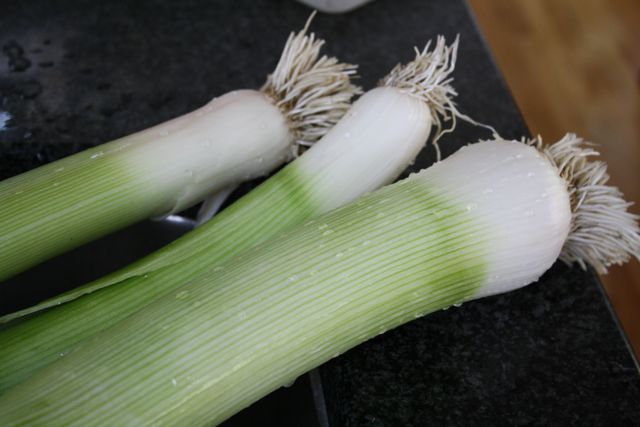
LEEKS:

A few years ago we left some leeks outside to overwinter without mulching or protection and surprisingly once the ground thawed, we were able to enjoy them well into mid spring.  Anytime storage can happen without jars and outside of the freezer is a nice plus.  Less work.  Once a staple vegetable in Europe, leeks are enjoying a "comeback" in the culinary world.  They can be used in place of onions although they are more pungent.  As part of the allium family (garlic, onions, chives, scallions), leeks have not been as rigorously studied as garlic in the medical studies.  However, because of the similarity of compounds, one can extrapolate the health benefits found in its relatives nutritional profile.  Leeks are high in manganese, folic acid, vitamins C and B6.  This year in a meta-analysis published in the journal Gastroenterolgy, it was found that large consumption of allium vegetables reduced the risk for gastric cancer.  To reduce the risk, one would need to consume 20 grams per day or the equivalent of a head of garlic.  That's really not much at all.  That study looked at prevention of disease but there are many non-clinical studies that support the organosulfur constituents in garlic have activity against certain cancerous cells.  That means treatment not just prevention.


LEEK TIPS:

When I was a cooking novice, I used to follow recipe instructions like a chemistry textbook.  I would literally use just the white parts of the leeks and discard the rest.  Now I know better!

1. Use leeks from the white to the pale green portion.  The dark green tops can be used to flavor stocks but tend to be more cabbage-like rather than onion-like in flavor.

2. Buy leeks with some of their tops on, if you can.  The tops will indicate how fresh your leeks are.

3. Don't stress about washing leeks.  The way they are grown cause grit and dirt to accumulate between some of the leaf layers.  Instead of some suggestions that tell you to soak the vegetable in water to loose the dirt, I just chop up what I need, place it in a colander and rinse.
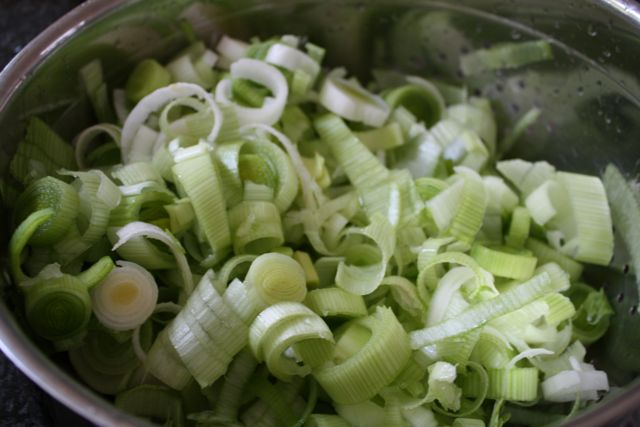
 Just chop and rinse


RECIPE: Creamy Leek Soup

This soup is best made 1-3 days ahead so that the flavors can develop.  It can be also frozen (just don't add the cream) and reheated on a lazy winter's night.  Serve with some crusty bread and a head of roasted garlic to increase your allium intake!

  • Leeks 3 pounds, trimmed and chopped, using white and pale green parts only
  • 1 medium onion, chopped
  • 1 large carrot, chopped
  • 1 small celeriac root plus tops OR 2 celery ribs
  • 1 teaspoon salt
  • 1/2 teaspoon black pepper
  • 1 stick (1/2 cup) unsalted butter
  • 1 small boiling potato (6 ounces)
  • 1/2 cup dry white wine
  • 3 cups chicken stock or vegetable stock
  • 3 cups water
  • 1 bay leaf
  • 1 1/2 cups fresh flat-leaf parsley leaves
  • 1/4 cup all-purpose flour**
  • 1/2 cup creme fraiche

To make gluten free, omit the instructions for roux (butter and flour) and add an additional large potato instead.
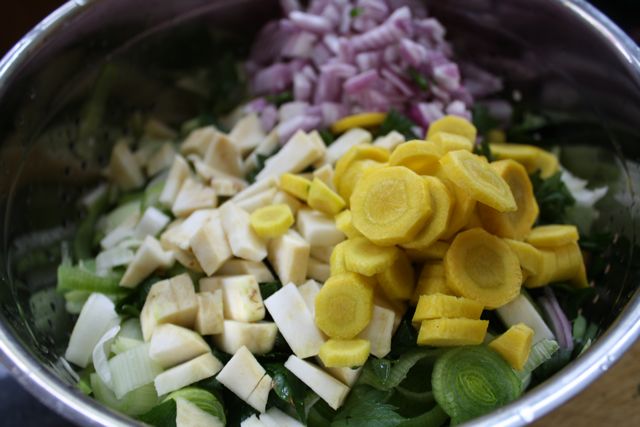
The beautiful thing when you grow food is to realize how much of what you've grown is going into the pot of food you're cooking. Either from the ground or from storage everything in this colander including the yellow carrots, celeriac and celeriac tops, to the leeks are all grown here. The rest of the recipe we provided the potatoes, parsley and even a fresh bay leaf! Rewards indeed.

Instructions:

Wash sliced leeks in a large bowl of cold water, agitating them, then lift out and drain well in a colander.

Cook leeks, onion, carrot, celery, salt, and pepper in 4 tablespoons butter in a 5- to 6-quart heavy pot over moderate heat, stirring occasionally, until softened, about 8 minutes. Peel potato and cut into 1/2-inch cubes, then add to onion mixture along with wine, stock, water, and bay leaf. Bring to a boil, then reduce heat and simmer, partially covered, until vegetables are tender, about 15 minutes.

Stir in parsley and simmer soup, uncovered, 5 minutes. Discard bay leaf and keep soup at a bare simmer.

Melt remaining 4 tablespoons butter in a 1-quart heavy saucepan over moderate heat, then add flour and cook roux, whisking, until golden, about 3 minutes. Remove from heat and add 2 cups simmering stock (from soup), whisking vigorously (mixture will be thick), then whisk mixture into remaining soup and return to a simmer, whisking.

If you have time, let the soup cool then blend it depending on the consistency you like.  I find a immersion hand blender works beautifully without all the mess.  Reheat soup, then season with salt and pepper.

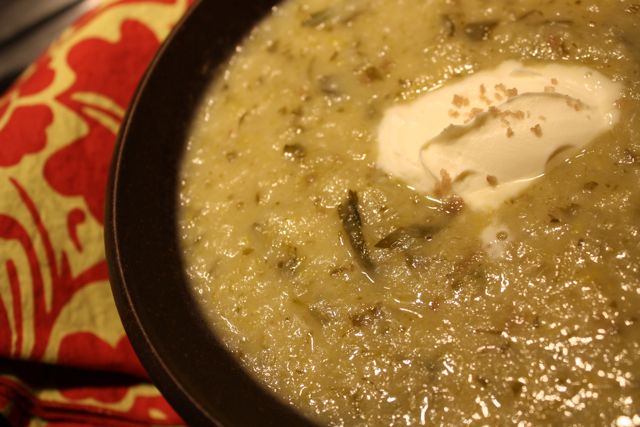
Serve soup topped with a large dollop of cream fraiche.

Adapted from Gourmet Magazine May 2007


Thursday
Oct082009

Q&A with Hook Mountain Growers

Miriam K asks: 

What can you recommend for growing in the winter? I work with little kids and the process of planting is meaningful and educational on so many levels. what would you recommend? Thanks!


 OUTDOORS

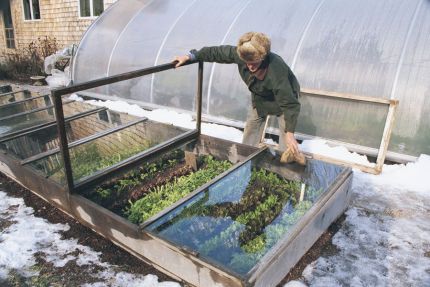
There are 2 considerations when growing in the fall and winter season.  Daylight length and temperature.  We're now in early October which obviously means the days are getting progressively shorter.  As the days get shorter, growing does continue but gets severely stunted. And as the days get colder, there are only certain vegetables that like the cooler temperatures.  Usually, the latest one can plant is mid October and the only vegetable you can do that with is spinach, at least in zone 6 (find your zone).  The issues with growing from seed at this time is that the plant needs to establish a certain amount of maturity so it can continue to produce for you all winter long.  If you plant too late, you'll have a tiny seedling that will sit there for months and growing will be severely stunted.  This situation I described can work in an outdoor "cold frame" which is like a micro greenhouse, or,  can also be simulated with a "low tunnel" which is a system of a short hoops and a thin fabric called a floating row cover that lets in light and rain while retaining heat. 

photo: Ruth LivelyThis creates a condition where temperatures can be kept about 20 degrees higher than the outside temperature and will protect the plants from excess moisture and wind, which are the other crop killers.  This system can also be used to extending the growing season for existing plants.  For example, we have a bed of bell peppers filled with green fruit waiting to turn yellow, red and chocolate but we're very close to the first frost date (zone 6).  By covering this bed, we enable the peppers to have a longer growing season than what is typical in this region.  Or we have lettuces and mustard greens that we planted in early September that can tolerate cold temperatures but not super low temperatures.  This gives them the protection to continue growing for us throughout the winter months.  With a cold frame system, 2 frames (about 4x8 ft) for each family member should provide fresh food all winter.  This, of course, assumes that you built and planned and planted a majority of things by the end of summer.

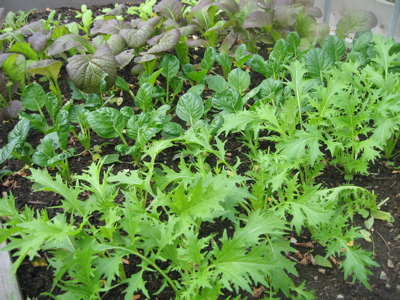
4 different baby mustard greens


INDOORS

Growing indoors during this time is more difficult given the lower light levels but it's not impossible.  For an educational activity for kids, I think is an amazing way to teach kids to nurture something and provide responsibility.  Beyond that, I think they come away with an appreciation of where their food comes from and hopefully will acquire a taste for vegetables!  Alice Waters, chef and local food advocate, does a lot of work establishing this system of growing food and cooking in progressive school systems. In terms of what you can grow under lights during the fall and winter, I think leaf lettuces would be the quickest and easiest choice.  They like cooler temperatures and you'll be able to cut off baby lettuces and then allow the plant to regrow providing you with fresh salad over the season.  We call these "cut and come again."

What you will need for this endeavor are some basic tools. 

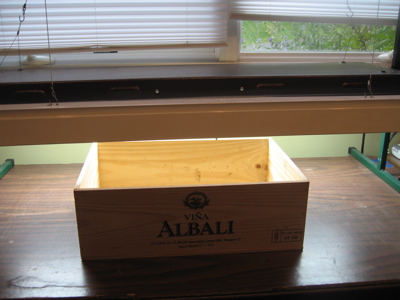
1) A fluorescent growlight system can range anywhere from $45-100 depending on the size.

2) Wooden wine boxes.  I'd go to your local vintner and ask for any old wooden crates.  This may be harder to find as most things are shipped in cardboard.  I'd then drill a few holes on the bottom for water drainage.

3) Organic potting soil to fill the box.

4) Seeds.  There is a huge variety of lettuces which can be ordered through the mail.  I like Johnny's Seeds in Maine.  You can do a mixed variety or you can select ones that you like (arugula, frisee etc).


In the planting box, seed closely in moistened soil.  Ideally you want to have a bottle mister and not pour water directly into the box especially when plants are just emerging.  Keep the soil continually moist and watch for the first signs of growth.  At that point, put the box under the grow lights for at least 10-12 hours per day.  Depending on soil conditions, you may want to add diluted organic fertilizer (seaweed base) every few weeks for continued production. 


Hope this helps and happy growing!