alliums ameraucana Anthony Bourdain aphids Appleseed Permaculture aquaponics arthritis artichokes Asian Vegetables aussie basil baby chicks baby turnips bearss lime bee keeping beet greens beneficial insects benner tree farm Biochar Bitter Melon blight blooming hill farm boothby blonde cucumber brix broccoli brussels sprouts cabbage cabbage hill farm camp hill farm cancer caraflex celeriac chicken coop chickens children chinese tamale chives cilantro cilantro root coconut cold frames collard greens Compost coriander corn crop rotation cruciferous crucifers cucumber Dan Barber dan kittredge Dave Llewellyn detox dirty dozen dragon fruit Dutch white clover dwarf citrus eggplant Elderberries factory farms farm to table farmer's market farmers markets Fava beans ffarm to table fish oil flea beetle flowers food allergies food combining food miles founding farmers four wind growers Fred Kirschenmann french bulldog G6pd deficiency garlic garlic festival garlic scapes geese Glynwood grass-fed beef Great Outdoors Listening Tour green tomatoes greenhouse growing indoors Hanalei Hemlock Hill Farm heritage turkey heritage USA hudson valley farms hurricane Irene hyssop iced tea infections influenza Insect control isothiocyanates joan gussow jolie lampkin joong kaffir lime kale Kauai kohlrabi korean licorice mint Ladybugs late blight leeks lettuces local food locust tree maine avenue fish market menhaden meyer lemon mycelia mycorrhizal natural fertilizers nectary nightshades No Reservations Nurse cropping nutrient density okra organic Baby food organic christmas tree Organic Pest Control Parsley Paul tappenden peas Permaculture pesticides pesto petite watermelon plant sap pH plymouth barred rock pole beans potatoes preserving food purple basil qunice Radish Greens rainbeau ridge farm raised beds rampicante raw food real food campaign red hook Rockland Farm Alliance ronnybrook farm row covers salt-preserved duck eggs sambucus nigra seed saving seedlings Sheet mulching small space soil analysis soil blocks soil conductivity sorrel Squash Vine Borer star fruit sugar snap peas sustainability sustainable fishing Swiss Chard tabbouleh TEDx Manhattan terracing three sisters tomato sauce tomatoes trellis trovita orange turkana farms Tuttle Farm urban zen volt white clover winter harvest Winter Squash Young Farmers Conference
Indispensable Books and Resources
  • Edible Forest Gardens (2 volume set)
    Edible Forest Gardens (2 volume set)
    by Dave Jacke, Eric Toensmeier
  • The Winter Harvest Handbook: Year Round Vegetable Production Using Deep Organic Techniques and Unheated Greenhouses
    The Winter Harvest Handbook: Year Round Vegetable Production Using Deep Organic Techniques and Unheated Greenhouses
    by Eliot Coleman
  • The Biological Farmer: A Complete Guide to the Sustainable & Profitable Biological System of Farming
    The Biological Farmer: A Complete Guide to the Sustainable & Profitable Biological System of Farming
    by Gary F. Zimmer
  • The Garden Primer: Second Edition
    The Garden Primer: Second Edition
    by Barbara Damrosch
  • 1500 Live LadyBugs - A GOOD BUG! - Lady Bug
    1500 Live LadyBugs - A GOOD BUG! - Lady Bug
    Organic Insect Control
  • Acres U.S.A.
    Acres U.S.A.
    Acres U.S.A.

    The best farming and growing magazine money can buy!

  • Seed Starter Soil Block Maker Makes 4 Medium Blocks
    Seed Starter Soil Block Maker Makes 4 Medium Blocks

    2" Soil Blocker

  • Mini Soil Blocker
    Mini Soil Blocker
  • New York City Farmer & Feast: Harvesting Local Bounty
    New York City Farmer & Feast: Harvesting Local Bounty
    by Emily Brooks
  • What Doctors Eat: Tips, Recipes, and the Ultimate Eating Plan for Lasting Weight Loss and Perfect Health
    What Doctors Eat: Tips, Recipes, and the Ultimate Eating Plan for Lasting Weight Loss and Perfect Health
    by Tasneem Bhatia, Editors of Prevention


THE DAILY BROADFORK

Short journal entries detailing the nuts and bolts of our ventures in growing food at our micro-farm

Entries in Nose to Tail (3)

Tuesday
Jun142011

The Intern's Corner: Garlic Scapes, Fava Bean Tops and Micro Carrots

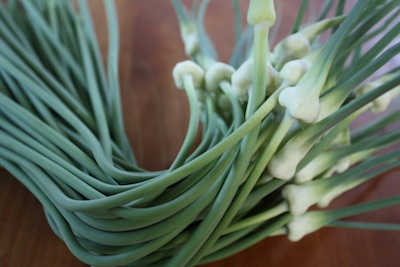
Garlic ScapesWe begin this spring's harvest a little later than usual due to the long cold wet weather a few months ago (though we had a long lettuce harvest!).  Finally chard, kale, edible flowers and various herbs are in abundance.  The smaller jewels of the harvest are the thinnings from overcrowded crops.  When you seed carrots, you do so closely but at some point you need to sacrifice and pull them to make room for larger carrots to grow.  These are the products, like tiny micro carrots, you'll never see for sale at the farmer's markets, usually only at higher end restaurants.  Garlic scapes fall in that category though they can now be found for sale for a fleeting time at the markets.  Here is Pippa's experience using scapes, fava tops and micro carrots in a recipe.  If you are ever invited to taste Pippa's cooking, don't pass up the opportunity!


We are just beginning to get our first taste of what our work on the farm will yield. Rissa and I harvested garlic scapes and thinned the yellow and purple carrots. Garlic scapes are the stem that grows up from the bulb and will eventually flower. They are removed not only for eating, but also to ensure that the plant puts all of its energy into developing the bulb, rather than the flower.  We went home with an abundance of scapes, a few baby carrots and some tops of the fava bean plants (Click HERE for why one might clip the tops of fava beans) Immediately I began concocting the best way to utilize my precious crops. Pam mentioned that fava tops are often used in pasta dishes and Rissa had just recently made a garlic scape pesto. So, inspired by both I decided to make a pesto-like sauce for pasta and add the fava tops and a few other greens left over from various farmers markets and create flavorful garlic-scapey green pasta! I started by grilling the scapes to impart a nice smoky flavor. 
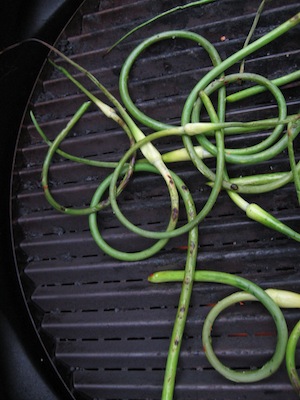
I added them to the food processor with a half cup of a mix of walnuts and pistachios (because that’s what I had – any nuts will do), 1/3 cup of parmesan cheese, a Serrano chili (this is optional..we just happen to love heat in our food!), and half a red onion.
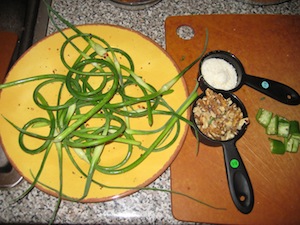
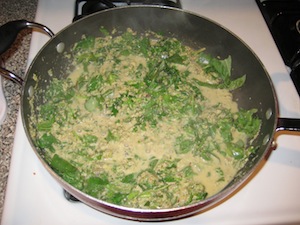
While the food processor is going, stream in a few tablespoons of olive oil. I then added the scape mixture to a hot pan and added 1/3 of a cup of white wine and a few ladles of starchy pasta water.


I let that cook down and the wine to reduce and then added the cooked pasta to the sauce (we used whole wheat spaghetti – but really any string pasta would work) and then folded in all the lovely greens.
 

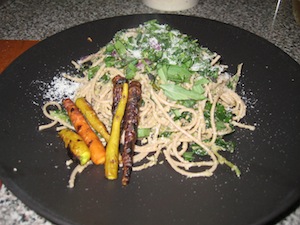
I served it topped with a sprinkle of parmesan and some of the reserved fava tops. Add salt and pepper to taste. I also grilled those gorgeous baby carrots at the same time that I grilled the scapes. The end product was delicious! It tasted very fresh and the flavor of the greens and scapes really shone! The greens I used were a combo of red Russian kale, purslane, callaloo and fava tops- basically it’s a great way to use whatever left over greens you end up with!…I still have some scapes and fava tops left. Any suggestions? Happy cooking!   ~Pippa
Wednesday
Jul152009

Weekly Musings: Cilantro/Coriander Root


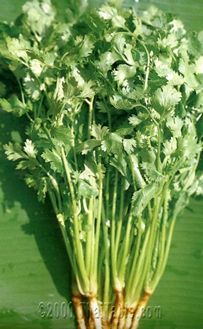
Cilantro, also known as coriander or Chinese parsley, is a uniquely pungent herb used in many Latin and Asian dishes. Though most people use the leaves, every part of the plant - leaf, stem and root - can be eaten. Medicinally, it is used for a variety of gastrointestinal dysfunctions: indigestion, nausea, diarrhea, lack of appetite and as an antiflatulent. It is also used as a chelating agent to remove mercury in the body. It's commonly seen in many natural detoxification protocols but few clinical studies are available to support this use. Coriander has been found to have antibacterial, antifungal, and antiparasitic properties in laboratory and animal studies and has been used to prevent food poisoning.  A study from Berkeley California found that the fresh leaves possessed bacteriacidal activity against Salmonella.  No wonder it's a common addition to cuisines of many third world countries. These are all important considerations given last year’s salmonella outbreak leading the the temporary unavailability of tomatoes and jalapenos. In addition, it is a rich source of vitamin C, calcium, magnesium, potassium, and iron. Use this this herb liberally!


A lot of people have difficulty growing cilantro. The summer heat often leads to bolting and the ideal growing conditions are sunny but cool days. Finding an area that gets early morning or late afternoon sun, but shaded during the hottest part of the day, may help. You can also as try seeding more closely together so that the leaves provide some shade to keep the soil cooler. If, in the end, you only get bolted cilantro, there are various applications for its use.

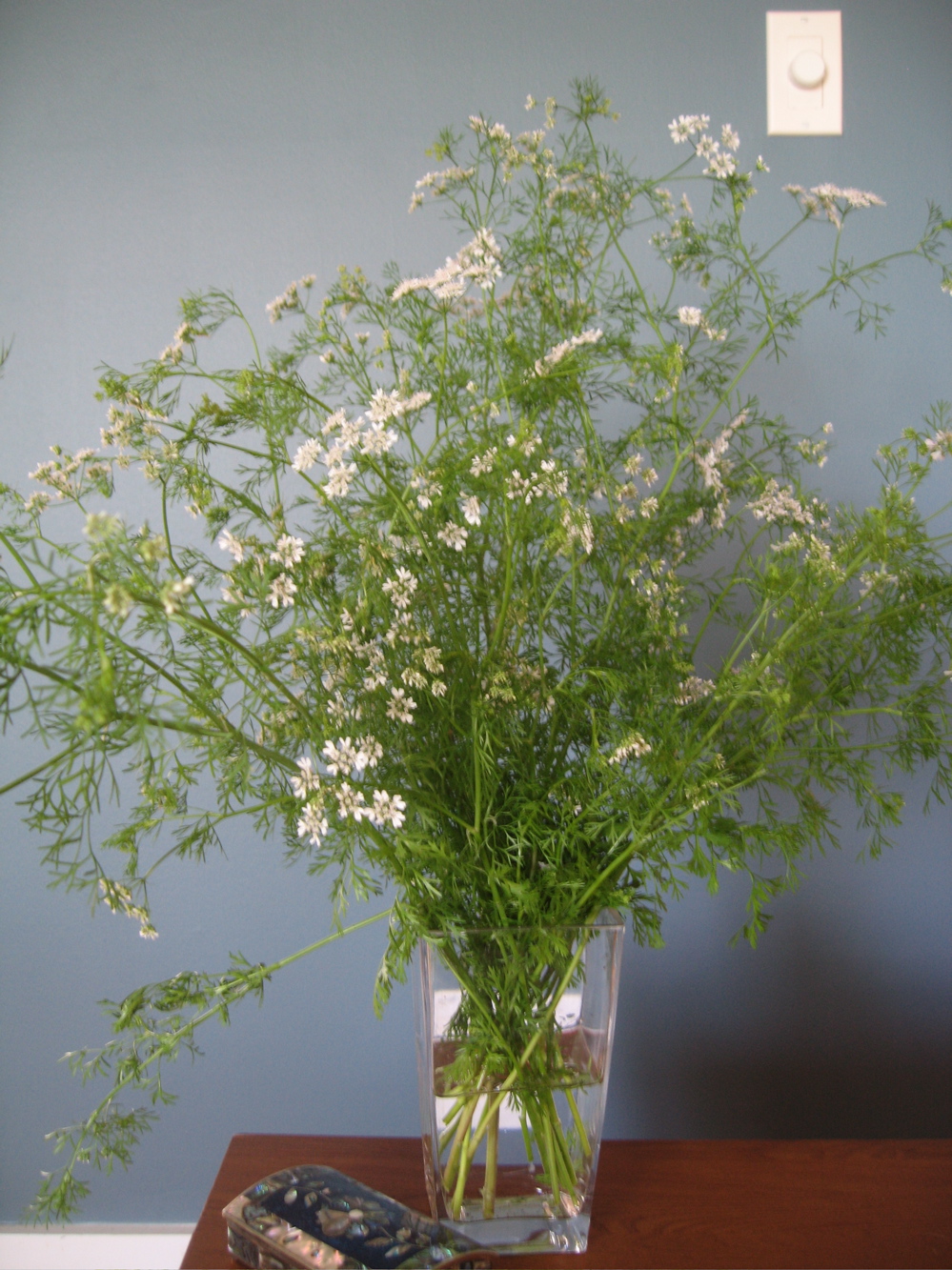
The lacy flowers attract beneficial insects to the garden. This is an especially important consideration when growing food organically. We use a variety of different “beneficials” flowers to do what pesticides do - get rid of damaging insects. Cilantro attracts hoverflies which prey on aphids and mealybugs. If you leave the flower to seed, the seed can be used as a culinary spice. The flowers are also beautiful in flower arrangements.

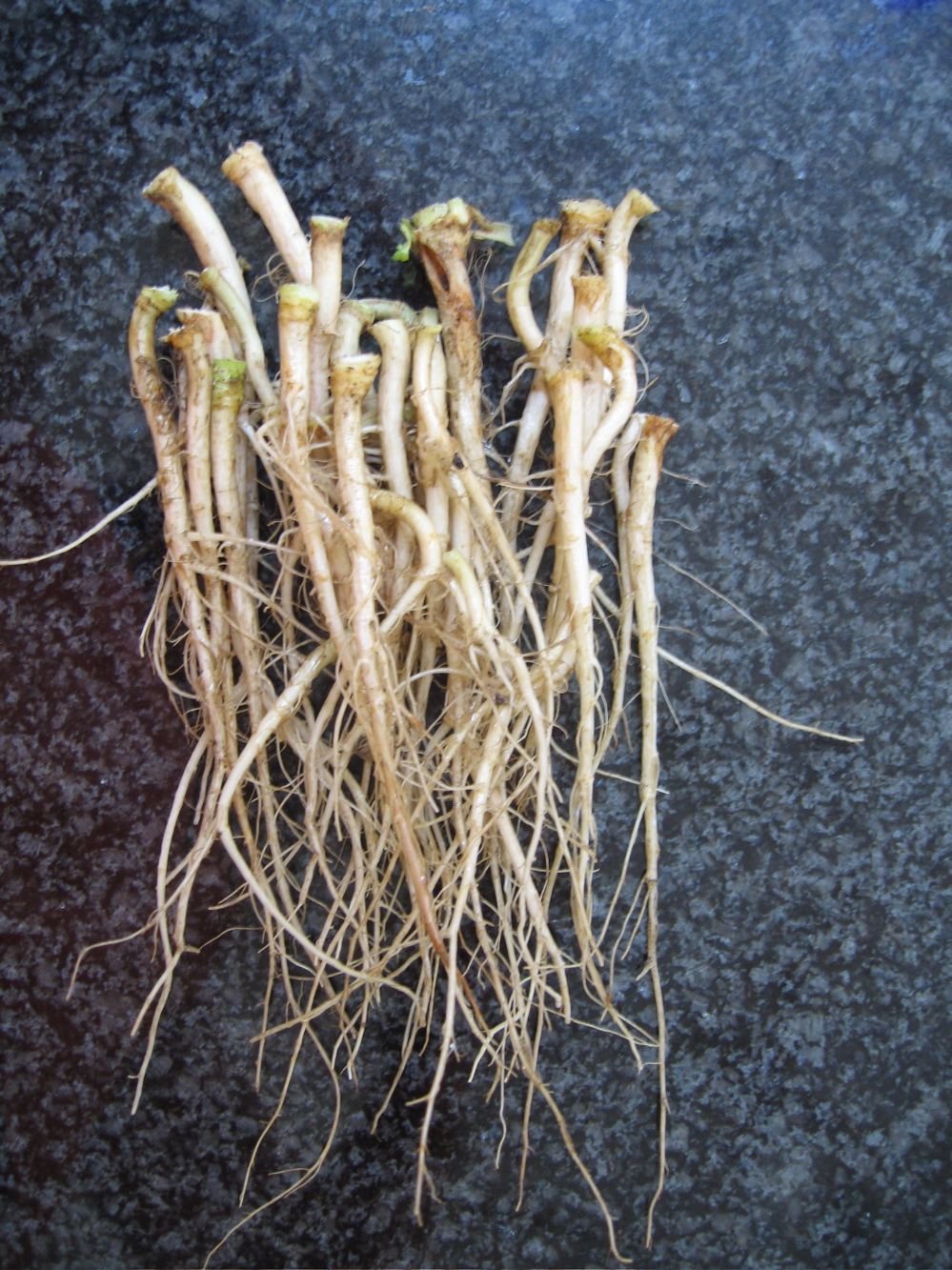
Most people discard the stems and roots of the plant.  Don't throw it away!  Commonly in Thai cooking, the roots are used in soups and curry pastes. What I do is clean and dry the roots and freeze them. Over time, I’ve amassed a nice amount of coriander root to use in my cooking throughout the year. No need to defrost the roots when you need them, they can be chopped and pounded while still frozen.


Peppercorn-Coriander Root Flavor Paste


Use this as a marinade for fish, chicken or pork. I’ve used this with grilled chicken.  Let the marinade sit for 3 hours.

2 tsp black peppercorns
5-6 large garlic cloves, coarsely chopped (about 2 Tbs)
3 Tbs coarsely chopped coriander roots
Pinch of salt
1 tsp Thai fish sauce

Place peppercorns and garlic in a mortar and pound to make a paste. Add coriander roots and salt and continue pounding to make a paste. You can use a small blender or food grinder instead. Stir in fish sauce. Makes 2-3 tablespoons of paste. Can be stored in a well-sealed jar for up to 4 days.

Adapted from the book Hot Sour Salty Sweet by Jeffrey Alford and Naomi Duguid


Farmer Pam, MD

Sunday
Jun282009

Weekly Musings: Beet Greens

Last winter, when we were trying to plan non-material holiday gifts for the family, I asked my sister-in-law if she'd enjoy a CSA (community supported agriculture) subscription enabling her family to access local produce on a weekly basis from the spring through the fall.  Her hesitation was that she didn't want to be stuck with vegetables she didn't know what to do with or that would require too many precious hours trying to figure out what to do with.  This is the issue that a lot of people have with CSA's - no voice in the choice of what they get.  Probably conjures up, to some, what socialism must feel like: you get what you get and that's it.  But with a little effort, and a change in thinking about food, it's probably a really beneficial thing in the end when you consider how little we rotate the typs of food we eat.  And in my experience, repetitious eating of one type of food has led the susceptible some to develop food intolerances or food allergies.

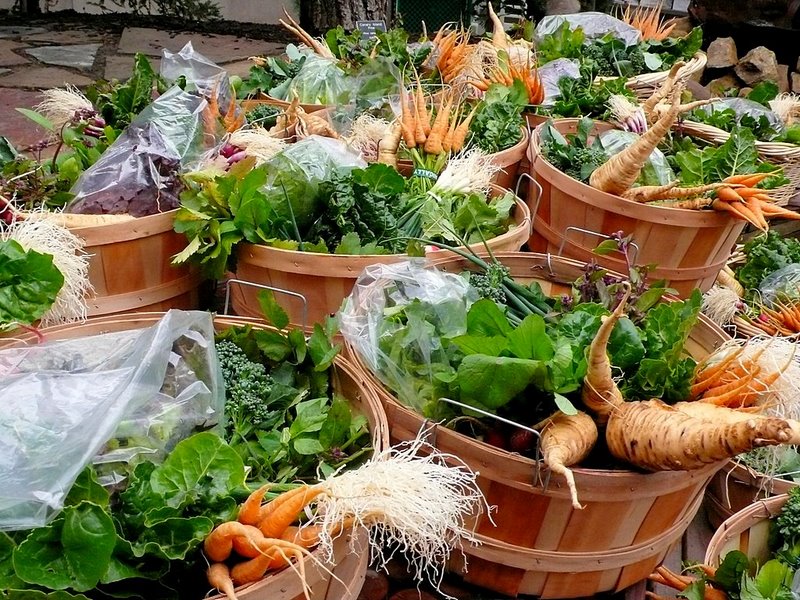
One interesting reflection is this: my homestead/farm is a giant CSA box and during this first full year of production, I'm feeling the challange of eating seasonally and locally on a large scale.  How many ways can I have english peas, sugar snap peas, and puntarelle (Italian dandelion)?  Just yesterday, I harvested 9 lbs of baby beets of which 6 lbs of those were beet greens.  Only recently have I seen beet greens packaged in salad bags at Whole Foods.  Typically, they were discarded or given away for free from the grocer years ago, but I've witnessed their revival as a "new" addition to the green leafy vegetable repetoire.  Beets can be easily stored in the refrigerator crisper if you remove the greens and leave about an inch of stem in place but the greens need to be eaten in a much shorter period of time.  I counsel people very frequently on food as either part of prevention or for therapeutic reasons and I find myself, like some of my patients who almost exclusively enjoy a brown, white and tan diet, a little afraid of the large mound of beet greens that lay in front of me.  There's the obvious sauteeing of the greens with garlic and oil.  Simple, nice, but over the next week, my taste buds need more to interest me.

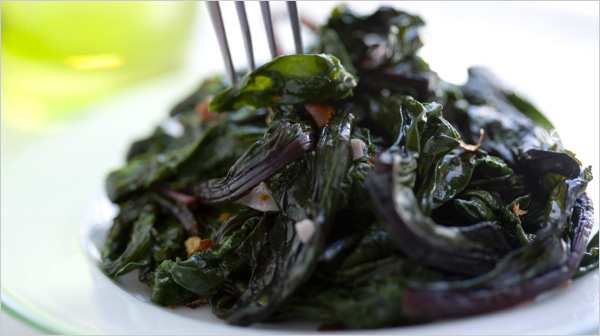
photo from The New York Times 

 Here are some interesting recipes I have lined up for the next week, all found on the web:

1. Sauteed Beet Greens (non vegetarian)

2. Sauteed Beet Greens (vegetarian)

3. Roasted Beet Salad with Beet Greens and Oranges (from Epicurious)

4. Beet Green Pasta (from Alice Waters Chez Panisse Vegetables)

If a structured recipe is not your thing, Chowhound has wealth of ideas from many people answering a blog query on ideas for beet greens.


Eat mindfully!

Farmer Pam, MD