alliums ameraucana Anthony Bourdain aphids Appleseed Permaculture aquaponics arthritis artichokes Asian Vegetables aussie basil baby chicks baby turnips bearss lime bee keeping beet greens beneficial insects benner tree farm Biochar Bitter Melon blight blooming hill farm boothby blonde cucumber brix broccoli brussels sprouts cabbage cabbage hill farm camp hill farm cancer caraflex celeriac chicken coop chickens children chinese tamale chives cilantro cilantro root coconut cold frames collard greens Compost coriander corn crop rotation cruciferous crucifers cucumber Dan Barber dan kittredge Dave Llewellyn detox dirty dozen dragon fruit Dutch white clover dwarf citrus eggplant Elderberries factory farms farm to table farmer's market farmers markets Fava beans ffarm to table fish oil flea beetle flowers food allergies food combining food miles founding farmers four wind growers Fred Kirschenmann french bulldog G6pd deficiency garlic garlic festival garlic scapes geese Glynwood grass-fed beef Great Outdoors Listening Tour green tomatoes greenhouse growing indoors Hanalei Hemlock Hill Farm heritage turkey heritage USA hudson valley farms hurricane Irene hyssop iced tea infections influenza Insect control isothiocyanates joan gussow jolie lampkin joong kaffir lime kale Kauai kohlrabi korean licorice mint Ladybugs late blight leeks lettuces local food locust tree maine avenue fish market menhaden meyer lemon mycelia mycorrhizal natural fertilizers nectary nightshades No Reservations Nurse cropping nutrient density okra organic Baby food organic christmas tree Organic Pest Control Parsley Paul tappenden peas Permaculture pesticides pesto petite watermelon plant sap pH plymouth barred rock pole beans potatoes preserving food purple basil qunice Radish Greens rainbeau ridge farm raised beds rampicante raw food real food campaign red hook Rockland Farm Alliance ronnybrook farm row covers salt-preserved duck eggs sambucus nigra seed saving seedlings Sheet mulching small space soil analysis soil blocks soil conductivity sorrel Squash Vine Borer star fruit sugar snap peas sustainability sustainable fishing Swiss Chard tabbouleh TEDx Manhattan terracing three sisters tomato sauce tomatoes trellis trovita orange turkana farms Tuttle Farm urban zen volt white clover winter harvest Winter Squash Young Farmers Conference
Indispensable Books and Resources
  • Edible Forest Gardens (2 volume set)
    Edible Forest Gardens (2 volume set)
    by Dave Jacke, Eric Toensmeier
  • The Winter Harvest Handbook: Year Round Vegetable Production Using Deep Organic Techniques and Unheated Greenhouses
    The Winter Harvest Handbook: Year Round Vegetable Production Using Deep Organic Techniques and Unheated Greenhouses
    by Eliot Coleman
  • The Biological Farmer: A Complete Guide to the Sustainable & Profitable Biological System of Farming
    The Biological Farmer: A Complete Guide to the Sustainable & Profitable Biological System of Farming
    by Gary F. Zimmer
  • The Garden Primer: Second Edition
    The Garden Primer: Second Edition
    by Barbara Damrosch
  • 1500 Live LadyBugs - A GOOD BUG! - Lady Bug
    1500 Live LadyBugs - A GOOD BUG! - Lady Bug
    Organic Insect Control
  • Acres U.S.A.
    Acres U.S.A.
    Acres U.S.A.

    The best farming and growing magazine money can buy!

  • Seed Starter Soil Block Maker Makes 4 Medium Blocks
    Seed Starter Soil Block Maker Makes 4 Medium Blocks

    2" Soil Blocker

  • Mini Soil Blocker
    Mini Soil Blocker
  • New York City Farmer & Feast: Harvesting Local Bounty
    New York City Farmer & Feast: Harvesting Local Bounty
    by Emily Brooks
  • What Doctors Eat: Tips, Recipes, and the Ultimate Eating Plan for Lasting Weight Loss and Perfect Health
    What Doctors Eat: Tips, Recipes, and the Ultimate Eating Plan for Lasting Weight Loss and Perfect Health
    by Tasneem Bhatia, Editors of Prevention


THE DAILY BROADFORK

Short journal entries detailing the nuts and bolts of our ventures in growing food at our micro-farm

Entries in Recipes (29)

Sunday
Sep182011

Successes and Failures of Growing after Hurricane Irene

Zapotec and Kellogg's Breakfast TomatoesEach season brings certain expectations and, of course, certain challenges that never remain the same.  Farming and growing is subject to weather fluctuations occuring more often due to climate change.  This year we had historic rainfall in the area starting with heavy downpours in the spring and culminating in the arrival of Hurricane Irene last month.  We lost our peas early becuase of late frosts, then many of the vegetables we seeded or the delicate transplants we placed in the ground would get hit by pounding downpours.  The repeated downpours led to soil erosion, and lastly, when there was no place for the water to penetrate, some beds were in standing water on a few occasions.  We were lucky that we had the harvest we've had to date, albeit much less than we expected for the year.  Unfortunately,  many farms from New York to Vermont were devastated and several CSAs were no longer able supply their customers with weekly drop-offs.  The Union Square Greenmarket had significantly less vendors.  This letter from Evolutionary Organics in New Paltz summed up the impact of Irene on some of our local farmers and is a must read for those who buy locally.


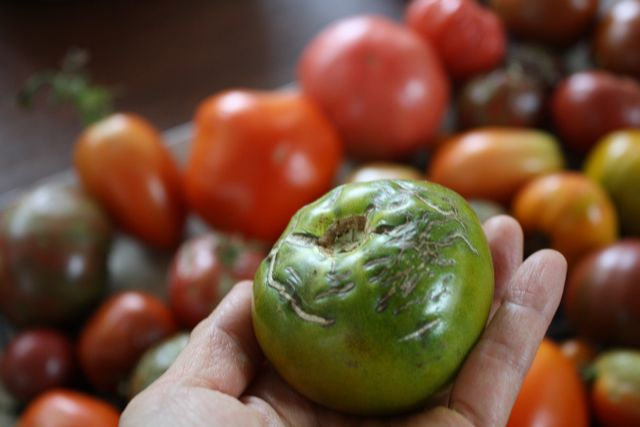
For the home gardener, many of whom grow tomatoes, this was not a good season.  It sure beat 2009 when we all had blight, but what started as a promising season of luscious fruit ended with overwatered tomatoes.  A sure sign of overwatering are tomatoes with fissures and cracks near the top of the fruit.  Multiple linear cracks near the stem of the tomato is a sign that your plant got way too much water.In case this is happening to you are not alone.  Having raised beds, which we encourage, helps with excessive water except in the case where you are getting 8 inches in an hour.  Our tomatoes were in standing water for periods of time.  They eventually drained but the damage was done, and repeatedly. Typically we are harvesting tomatoes well into the end of October but we'll be done by the end of September.  Such is life of a grower.
 Looking back at this season and also looking forward, these were the crops and varieties that did really well for us.  We plan on being fully stocked with these seedlings next spring at the farmers markets:


Favorite tomato varieties: Kellogg's Breakfast - meaty with little seeds and super productive.  Ramapo - gorgeous exemplary red tomatoes, Sungold Cherries, Pink Berkely Tie-Dye, and Lime Green Salad.

Other successes this year: Angled Luffa (Chinese Okra), Japanese Eggplant, Red Russian Kale, Leeks, Italian Rampicante Squash, Hot and Sweet Bell Peppers, and beets.

Wondering what your successes and failures were for the season?


Tonight's tribute to the end of the Nightshades is an absolute favorite sauce for pasta where the eggplant and tomatoes melt in to become a substantive sauce and the brininess of the kalamata olives and anchovies create the necessary pungency to make this a dish that stands out.  Trust me, it's amazing.  Be warned, it's a bit more time consuming than it looks from first glance but so worth the effort.


Recipe: Robust End-of-the-Summer Spaghetti

Ingredients

2 lbs of eggplant, peeled and sliced 1/2” thick
2 Red or yellow bell peppers, halved
1/4 cup olive oil
1 onion, diced
2 garlic cloves, minced
3 anchovies
2-3 lbs of ripe tomatoes, peeled, seeded and chopped
1/3 cup chopped parsley

1/2 cup kalamata olives pitted and chopped
3 Tbs capers (optional)
1 Tbs dried oregano
sea salt and freshly ground pepper
1 lb spaghetti
1 cup grated Parmesean cheese

1. Preheat broiled.  Arrange eggplant on cookie sheet and brush both sides with olive oil.  Broil both sides until soft and slightly browned about 10 minutes per side.  Oil peppers and broil then skin side up, until blistered.  Stack on top and steam for another 15 minutes then peel and dice into small squares.

2. Heat the 1/4 cup olive oil in a Dutch oven.  Saute the onions, peppers, garlic, anchovies and parsley over medium high heat until softened.  Lower the heat and add eggplant, tomatoes, olives, capers, oregano and 1/2 cup water or juice from tomatoes.  Season with S and P and simmer for 30 minutes to let the flavors develop.

3. Cook pasta in a large pot of salted water and drain.  Place in a large bowl with vegetables spooned over the top, showered with cheese and garnished with extra parsley.  Toss before serving.

Adapted from Deborah Madison's Local Flavors
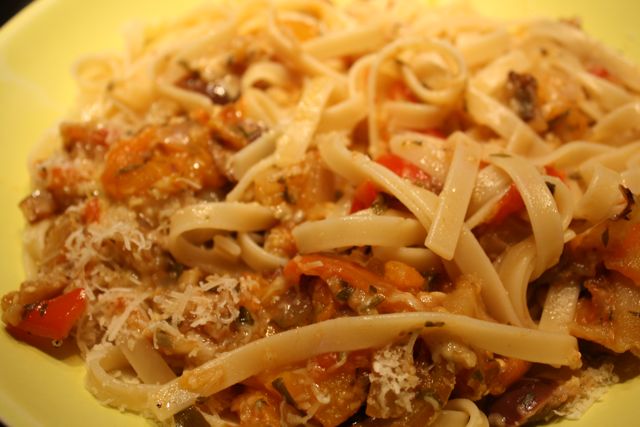
The amazing component here is the eggplant which literally melts and becomes the backbone of the sauce


Thursday
Aug042011

Uses for Purple Basil

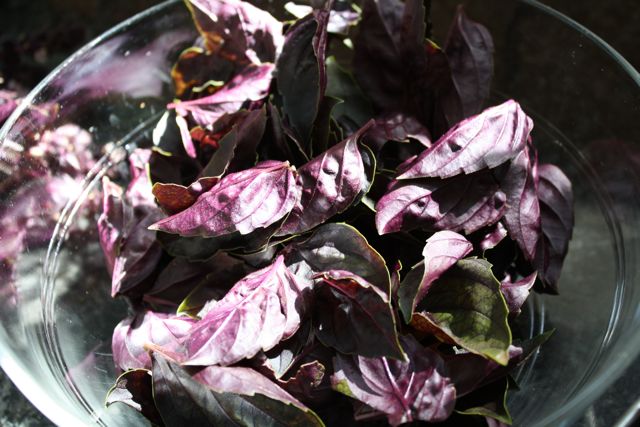
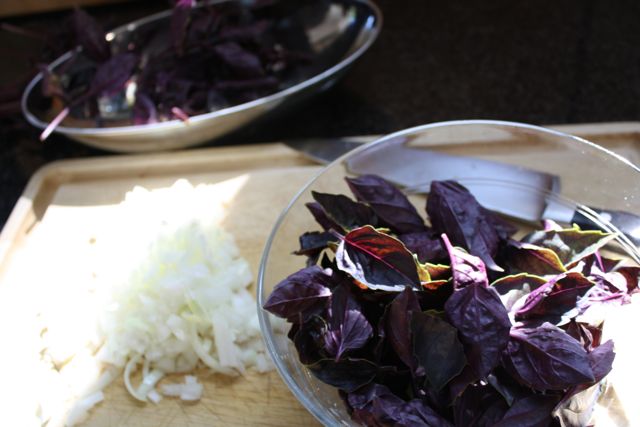
Purple Amythyst BasilWe're growing a lot of different varieties of basil: Sweet Italian, Holy, Thai, Purple and Purple Ruffled.  I have plenty of uses for the Thai, Holy and Italian varieties but I'm often stymied when my purple basil is lush and full, waiting for a culinary use.  I do use it as a finishing herb on top of salads, pastas and appetizers as a burst of purple color but it still leaves me with an abundance of the herb.  I've tried to make a pesto from it which came out beautifully in taste but a little disconcerting in color.  The final blackish eggplant color was not appetizing to everyone.  So what to do? 


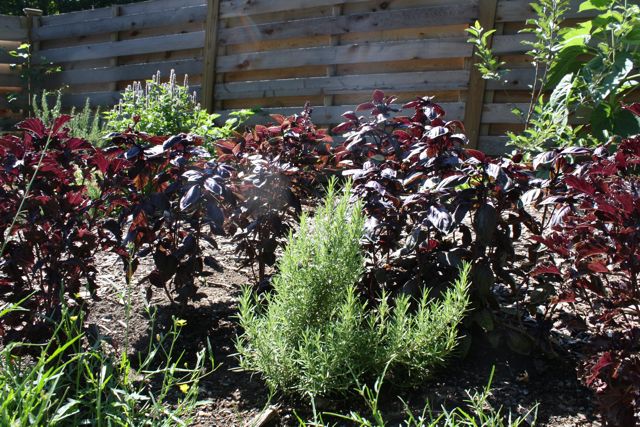
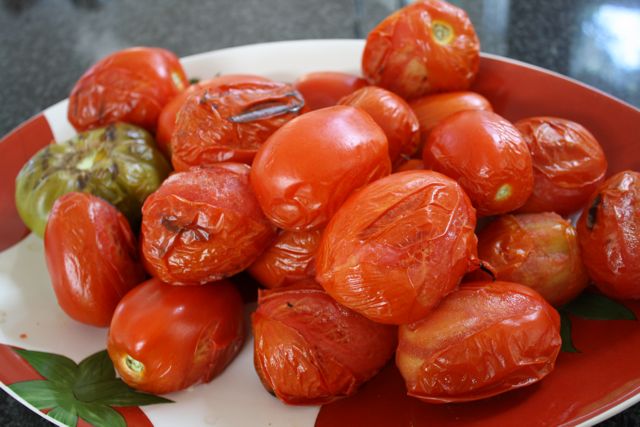
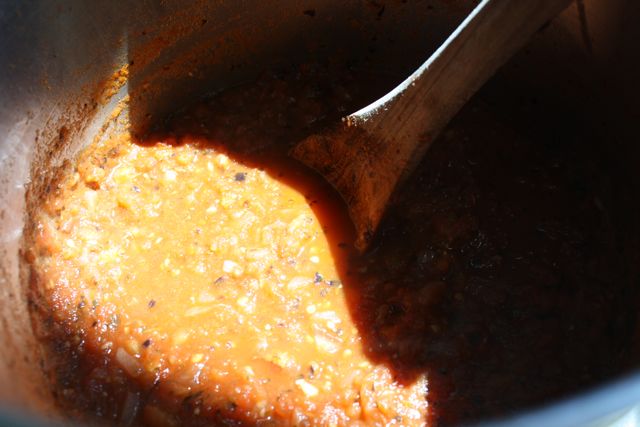
The basils make a gorgeous batch of aubergine color in the herb garden in our edible forest garden.  I figured my favorite grilled tomato basil sauce would be a perfect vehicle since it wouldn't change the color of the sauce.

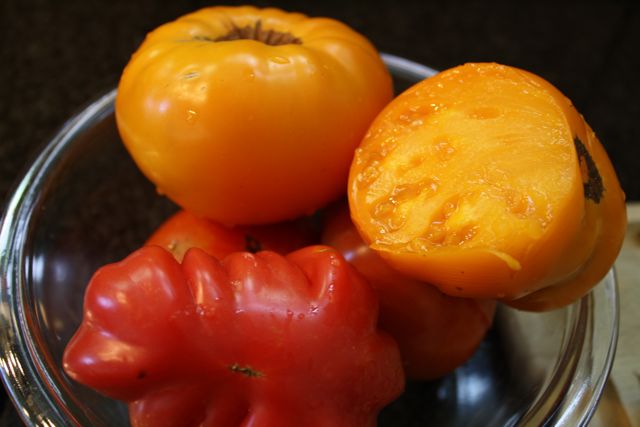
I used the prolific producing Plum Regal tomato since it's so meaty with little water content.  An Aunt Ruby's Green tomato snuck in there since it was super ripe

And recent harvested Spanish Roja garlic, Dakota Tears onions making the sauce virtually all from the farm.


And the finished product looks great.  The black specks which are the purple basil actually look like the grilled bits of tomatoes and the resulting sauce is, as usual, spectacular.

For the recipe posted last year (I have yet to find a better and easier marinara to make than this one).  Click HERE.  More tomato uses to come as we are swimming in tomatoes.


Friday
Jul082011

Herbal Abundance: Parsley - Tabbouleh Time!

It's early July and the much anticipated summer vegetables like tomatoes are beginning to ripen.  I'm told that last week at Union Square Market in New York, the most popular stand was a purveyor of hydroponically grown greenhouse tomatoes since most farms in the area don't have tomatoes ready to sell.  We all want those tomatoes unnaturally early since summer doesn't feel like summer without them.  The challenge in eating locally is to understand that you just can't have what you want when you want it even though it was conditioned in you for most of your life to expect tomatoes and garden salsa by June or July.  The only way you come to appreciate this truly, of course, is to grow it yourself and witness the entire process from seed to harvest.  What I do focus on as I hanker for that tomato salsa is to work with what I have in abundance for it won't be too long before I will be drowing in tomatoes and had enough of them for the season.

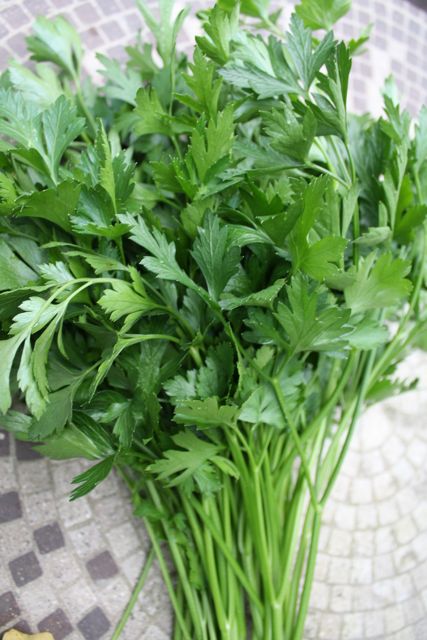
On the herb front, my flat leaf Italian parsley has been feeding me since the late spring mostly as chopped garnishes, tiny additions to my main meal, or juiced with kale into green shakes.  Now that there is more growing than I can handle I'm trying to find ways in which parsley becomes the centerpiece to a dish and not a minor component.


Health Benefits

Parsley is packed powerhouse of health.  Oftentimes it's added to detox regimens because it is high in chlorophyll and acts as a mild diuretic and laxative.  It's volatile oils contain high amounts of Vit K, C, thiamine, riboflavin and carotenes in addition to the flavanoids and antioxidants apigenin, apiol, and myristicin.  Some of these have anti-carcinogenic and anti-inflammatory properties.  Many cultures use parsley as a digestive aid and in combating garlic breath. Try eating a sprig of parsley the next time you consume a lot of garlic - it neutralizes the odor!


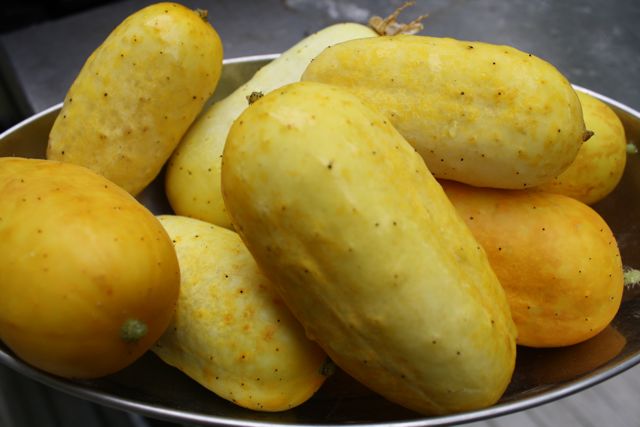
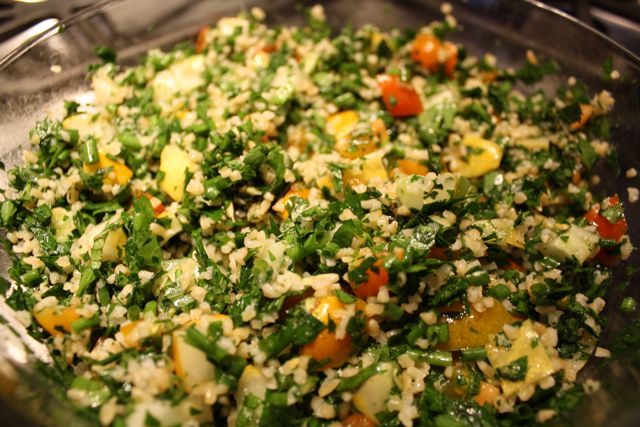
One classic parsley salad is Tabbouleh.  I like the authentic Lebanese version where parlsey dominates the salad rather than the Americanized version that has a higher proprtion on bulgur or cracked wheat.  And now that I have these gorgeous heirloom Boothby Blonde cucumbers and the start of a few tomatoes coming in, this was the perfect recipe of the day.

 A savory adulteration to the oiginal recipe: Boothby Blonde Cucumbers

RECIPE: Lebanese Tabbouleh

Ingredients

1/2 cup bulgur, fine or medium cracked wheat. Dont use the large variety
juice of 4 lemons
3 bunches fresh parsley, finely chopped (leaves only)
handful fresh mint, thinly sliced
3 medium tomatoes, diced
6 green onions, thinly sliced (with green stems) - I used chives since I have so much growing
1/2 cup extra virgin olive oil
sea salt to taste

(optional addition: though the authentic Lebanese recipe does not call for cucumbers, I couldn't resist adding them in for another texture and crunch in the salad.  Plus I had an abundance of beautiful heirloom Boothyby Blonde Cucumbers....

1. Soak bulgur in the juice of 2 lemons until the liquid is absorbed, about 20 minutes.  If you are using medium grade bulgur you may need to soak it in hot water but make sure the final product is DRY.

2. Combine chopped parsley, slivered mint leaves, scallions and tomatoes with the bulgur.

3. Add remaining juice of 2 lemons and add olive oil, salt to taste and mix once again.

Eat with romaine or cabbges leaves or just by itself.  Delish!

 Adapted from the website Nutrition Unplugged


Tuesday
Jun142011

The Intern's Corner: Garlic Scapes, Fava Bean Tops and Micro Carrots

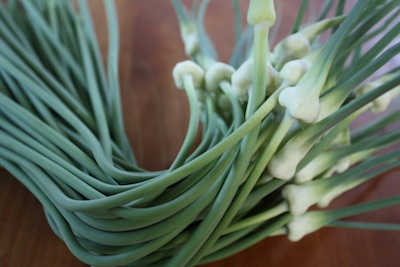
Garlic ScapesWe begin this spring's harvest a little later than usual due to the long cold wet weather a few months ago (though we had a long lettuce harvest!).  Finally chard, kale, edible flowers and various herbs are in abundance.  The smaller jewels of the harvest are the thinnings from overcrowded crops.  When you seed carrots, you do so closely but at some point you need to sacrifice and pull them to make room for larger carrots to grow.  These are the products, like tiny micro carrots, you'll never see for sale at the farmer's markets, usually only at higher end restaurants.  Garlic scapes fall in that category though they can now be found for sale for a fleeting time at the markets.  Here is Pippa's experience using scapes, fava tops and micro carrots in a recipe.  If you are ever invited to taste Pippa's cooking, don't pass up the opportunity!


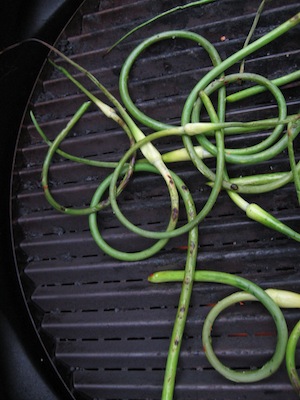
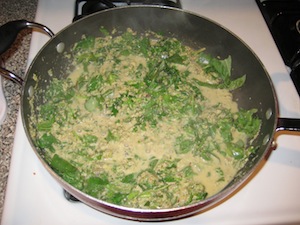
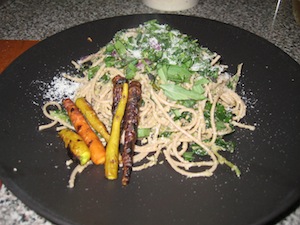
We are just beginning to get our first taste of what our work on the farm will yield. Rissa and I harvested garlic scapes and thinned the yellow and purple carrots. Garlic scapes are the stem that grows up from the bulb and will eventually flower. They are removed not only for eating, but also to ensure that the plant puts all of its energy into developing the bulb, rather than the flower.  We went home with an abundance of scapes, a few baby carrots and some tops of the fava bean plants (Click HERE for why one might clip the tops of fava beans) Immediately I began concocting the best way to utilize my precious crops. Pam mentioned that fava tops are often used in pasta dishes and Rissa had just recently made a garlic scape pesto. So, inspired by both I decided to make a pesto-like sauce for pasta and add the fava tops and a few other greens left over from various farmers markets and create flavorful garlic-scapey green pasta! I started by grilling the scapes to impart a nice smoky flavor. 

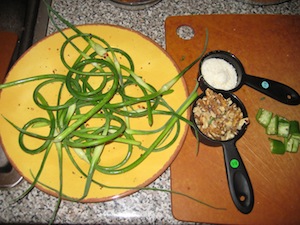
I added them to the food processor with a half cup of a mix of walnuts and pistachios (because that’s what I had – any nuts will do), 1/3 cup of parmesan cheese, a Serrano chili (this is optional..we just happen to love heat in our food!), and half a red onion.

While the food processor is going, stream in a few tablespoons of olive oil. I then added the scape mixture to a hot pan and added 1/3 of a cup of white wine and a few ladles of starchy pasta water.


I let that cook down and the wine to reduce and then added the cooked pasta to the sauce (we used whole wheat spaghetti – but really any string pasta would work) and then folded in all the lovely greens.


I served it topped with a sprinkle of parmesan and some of the reserved fava tops. Add salt and pepper to taste. I also grilled those gorgeous baby carrots at the same time that I grilled the scapes. The end product was delicious! It tasted very fresh and the flavor of the greens and scapes really shone! The greens I used were a combo of red Russian kale, purslane, callaloo and fava tops- basically it’s a great way to use whatever left over greens you end up with!…I still have some scapes and fava tops left. Any suggestions? Happy cooking!   ~Pippa

Thursday
Jun022011

The Intern's Corner: Can You Eat Radish Greens?

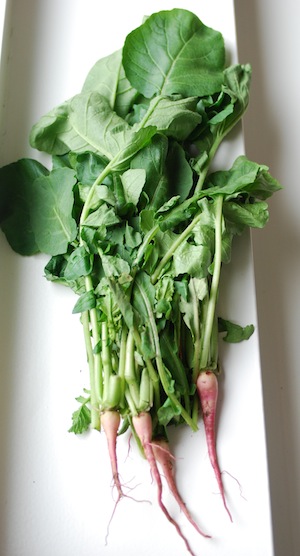
Photo by RissaIn my quest for "nose to tail" eating of vegetables, I was hoping one of my interns could find a way to utilize the radish greens I typically discard.  Rissa Landman (pronouced like Lisa but with an "R" and not to be confused with rapper RZA of the Wu-Tang Clan) is currently at Hunter College studying nutrition education, is also interning at Slow Food USA and is the mother to two gangsta French Bulldogs Spanky and Gus.  Here she writes about radish greens, which by the way, contain more vitamin C and calcium than the roots that we usually eat.


We stood around looking at each other and shrugging our shoulders. Are radish greens edible? Are they good? Pam had just thinned a bed of watermelon radishes and while the radishes themselves were still babies, they were topped off with large and beautiful green leaves. It would have been a shame to just discard them.

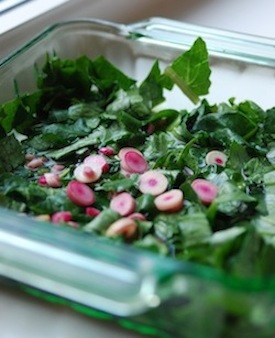
I did a little investigating and found out that they are indeed edible and quite versatile. I came across suggestions ranging from simply sautéed with garlic and olive oil to one using radish greens in a potato soup. The next night, we were making mussels with green coconut curry so I opted for a quick Vietnamese style pickling of both the greens and their baby radish companions.

They made a great side! The greens have a peppery taste – think very intense arugula – and a soft texture similar to spinach. They took well to the pickling – sweet, tart, and peppery - and the baby radishes added a nice crunchy texture. I have learned my lesson: the next time I find myself with a bunch of beautiful radishes, I won’t forget to utilize the greens. I would be a crime not to.

RECIPE: PICKLED RADISH GREENS

1 small bunch of radishes and their greens
1/4 cup rice vinegar 
2 tablespoons turbinado sugar 
1/2 teaspoon salt

Put vinegar, sugar and salt into a large bowl and whisk until sugar is dissolved. Add sliced radishes and chopped radish greens and toss to combine. Cover and refrigerate for at least 1 hour or up to several hours before serving.

Serves 2.

Photo by Rissa


Here are some other ideas from Chowhound for radish greens.