alliums ameraucana Anthony Bourdain aphids Appleseed Permaculture aquaponics arthritis artichokes Asian Vegetables aussie basil baby chicks baby turnips bearss lime bee keeping beet greens beneficial insects benner tree farm Biochar Bitter Melon blight blooming hill farm boothby blonde cucumber brix broccoli brussels sprouts cabbage cabbage hill farm camp hill farm cancer caraflex celeriac chicken coop chickens children chinese tamale chives cilantro cilantro root coconut cold frames collard greens Compost coriander corn crop rotation cruciferous crucifers cucumber Dan Barber dan kittredge Dave Llewellyn detox dirty dozen dragon fruit Dutch white clover dwarf citrus eggplant Elderberries factory farms farm to table farmer's market farmers markets Fava beans ffarm to table fish oil flea beetle flowers food allergies food combining food miles founding farmers four wind growers Fred Kirschenmann french bulldog G6pd deficiency garlic garlic festival garlic scapes geese Glynwood grass-fed beef Great Outdoors Listening Tour green tomatoes greenhouse growing indoors Hanalei Hemlock Hill Farm heritage turkey heritage USA hudson valley farms hurricane Irene hyssop iced tea infections influenza Insect control isothiocyanates joan gussow jolie lampkin joong kaffir lime kale Kauai kohlrabi korean licorice mint Ladybugs late blight leeks lettuces local food locust tree maine avenue fish market menhaden meyer lemon mycelia mycorrhizal natural fertilizers nectary nightshades No Reservations Nurse cropping nutrient density okra organic Baby food organic christmas tree Organic Pest Control Parsley Paul tappenden peas Permaculture pesticides pesto petite watermelon plant sap pH plymouth barred rock pole beans potatoes preserving food purple basil qunice Radish Greens rainbeau ridge farm raised beds rampicante raw food real food campaign red hook Rockland Farm Alliance ronnybrook farm row covers salt-preserved duck eggs sambucus nigra seed saving seedlings Sheet mulching small space soil analysis soil blocks soil conductivity sorrel Squash Vine Borer star fruit sugar snap peas sustainability sustainable fishing Swiss Chard tabbouleh TEDx Manhattan terracing three sisters tomato sauce tomatoes trellis trovita orange turkana farms Tuttle Farm urban zen volt white clover winter harvest Winter Squash Young Farmers Conference
Indispensable Books and Resources
  • Edible Forest Gardens (2 volume set)
    Edible Forest Gardens (2 volume set)
    by Dave Jacke, Eric Toensmeier
  • The Winter Harvest Handbook: Year Round Vegetable Production Using Deep Organic Techniques and Unheated Greenhouses
    The Winter Harvest Handbook: Year Round Vegetable Production Using Deep Organic Techniques and Unheated Greenhouses
    by Eliot Coleman
  • The Biological Farmer: A Complete Guide to the Sustainable & Profitable Biological System of Farming
    The Biological Farmer: A Complete Guide to the Sustainable & Profitable Biological System of Farming
    by Gary F. Zimmer
  • The Garden Primer: Second Edition
    The Garden Primer: Second Edition
    by Barbara Damrosch
  • 1500 Live LadyBugs - A GOOD BUG! - Lady Bug
    1500 Live LadyBugs - A GOOD BUG! - Lady Bug
    Organic Insect Control
  • Acres U.S.A.
    Acres U.S.A.
    Acres U.S.A.

    The best farming and growing magazine money can buy!

  • Seed Starter Soil Block Maker Makes 4 Medium Blocks
    Seed Starter Soil Block Maker Makes 4 Medium Blocks

    2" Soil Blocker

  • Mini Soil Blocker
    Mini Soil Blocker
  • New York City Farmer & Feast: Harvesting Local Bounty
    New York City Farmer & Feast: Harvesting Local Bounty
    by Emily Brooks
  • What Doctors Eat: Tips, Recipes, and the Ultimate Eating Plan for Lasting Weight Loss and Perfect Health
    What Doctors Eat: Tips, Recipes, and the Ultimate Eating Plan for Lasting Weight Loss and Perfect Health
    by Tasneem Bhatia, Editors of Prevention


THE DAILY BROADFORK

Short journal entries detailing the nuts and bolts of our ventures in growing food at our micro-farm

Entries in Recipes (29)

Tuesday
Apr122011

Fava Beans: Benefits of Pre-sprouting, Nurse Cropping and Companion Planting

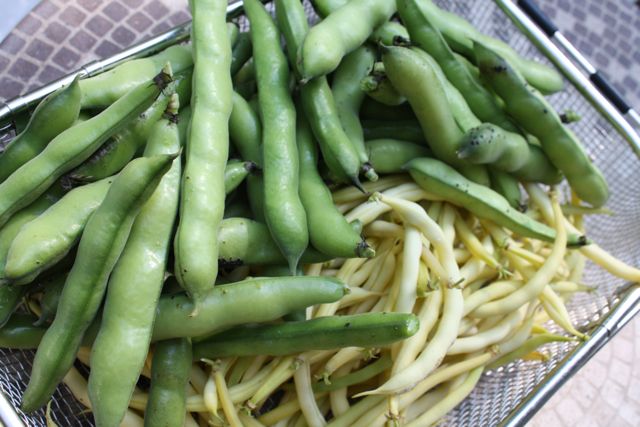
Last year's harvest of fava and yellow wax beansFava Beans, or broad beans as they are known in the UK, are the ubiquitous spring crop at farmer's markets.  Actually, they really show up in late May or June.  Here, at HMG, they are just being planted.  As a crop, they don't yield much when you take into account their spacing and the final weight before it makes it into your mouth.  Somewhat labor intensive, you have to remove both the thick pods and also the skins of the larger beans.  So a pound of beans gives you about a cup to a cup and a half of usable product. It is worth it?  Yes!  The taste, in my opinion, is sublime.  One of my favorite things to make is a fava bean and mint puree or just lightly steamed favas sauteed in a little butter with a light grating of parmesan cheese.  Of medicinal interest, favas may be helpful for those with Parkinson's disease as the bean, leaves and roots contain naturally occuring levo-dopamine, the medicine that is used to treat Parkinson's disease.  Also, individuals with G6PD deficiency (usually of Mediterranean descent) will develop a hemolytic anemia (lysis of red blood cells) if favas are consumed.

GROWING.  Direct seeding vs Sprouting

Planting these are easy.  You can directly seed these whopper-sized seeds and they germinate quickly.  I started them in 2" soil blocks weeks ago in hopes of getting an earlier crop.  They do root vigorously in soil blocks so don't wait too long to plant them out.  They are sown 6-8" apart in rows 18-36" apart.  Being greedy for space, I decided this year to be more bio-intensive about the planting and used John Jeavon's  guide to every 8" with smaller rows.  As they grow, there are a few issues to look out for.  The stems will need a light support, whether it be small bamboo stakes or creating a nest of twigs around the plants and rows.  Watch out for the black bean aphid or blackfly.  You can reduce the problem by pinching out the top 4" when the plant is in full flower and your first bean is forming at the base.  Don't throw these away; they can be lightly cooked and thrown into a pasta dish.  This is "nose-to-tail" growing!
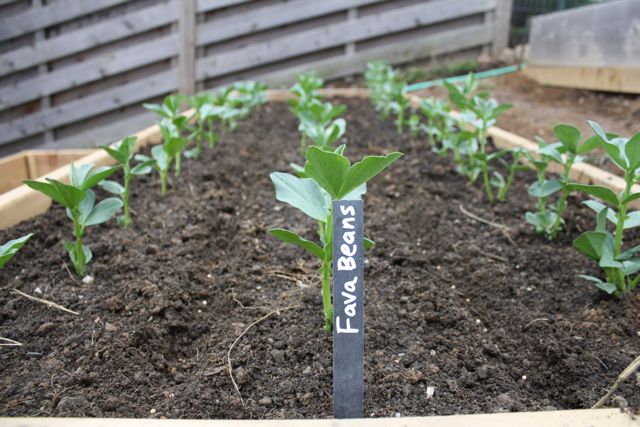
 Pre-sprouted favas planted and cilantro directly seeded in between.

COMPANION PLANTING AND NURSE CROPPING

Companion planting is a method of plant grouping so that each plant benefits from the proximity of the other.  Supposedly tomatoes are helped by basil and strawberries by borage, for example.  Conversely, there are things that should not be planted together, most notably fennel.  Supposedly nothing grows well when planted next to fennel.  From what I can tell, much of this is anecdotal through the collective decades of growing and observations people have made.  It would be interesting to see some science behind this.  It is rumoured that fava's enjoy the company of the herb savory and eggplant.  However, it is many weeks before I put eggplant in the ground and savory is nicely situated in the perennial herb area.  So I'm going to take a gamble and plant cilantro in between.  I am sick and tired of purchasing cilantro only to see it quickly go brown in the fridge days later.  It is an herb I use all the time and finding areas that I can succession grow these is sparse in a bio-intensive mini-farm.  This will be an experiment and I'll be sure to report back.
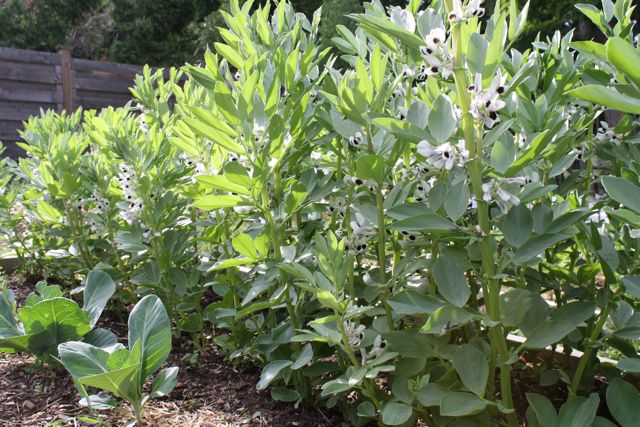
 Last year, I planted cabbage as a companion plant to favas.

Nurse cropping is another version of companion planting where by you can quickly grow a crop in an unused area next to another crop that has a longer growing cycle.  I do this with broccoli and lettuce.  By the time broccoli gets large enough, the lettuce below will benefit from the shading of the large waxy leaves.  This extends the growing season of lettuce and prevents bolting.  It's just another way of space efficiency and symbiosis.  Fava beans can be a nurse crop for potatoes.  As a legume, they'll fix nitrogen into the soil for the enlarging and hungry potato crop and they will be conveniently harvested well before the potato leaves take over in growth.  We'll also try this method for the first time this year and see what happens!


Hungry for a recipe?  Check out our friends at Grapes and Greens.  Deborah Soffel created this recipe of Artichoke Hearts, Spinach and Fava Beans Braised in White Wine that I hope to try once fava beans are ready in our farm.  Or maybe Hannibal Lecter's favorite: liver, fava beans and a nice chianti...


Friday
Dec102010

Winter's Sweet Frosty Kiss: The Transformation of Kale

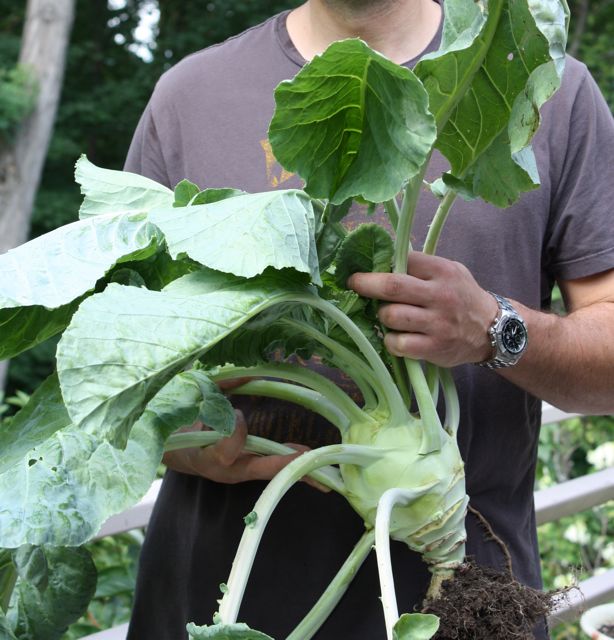
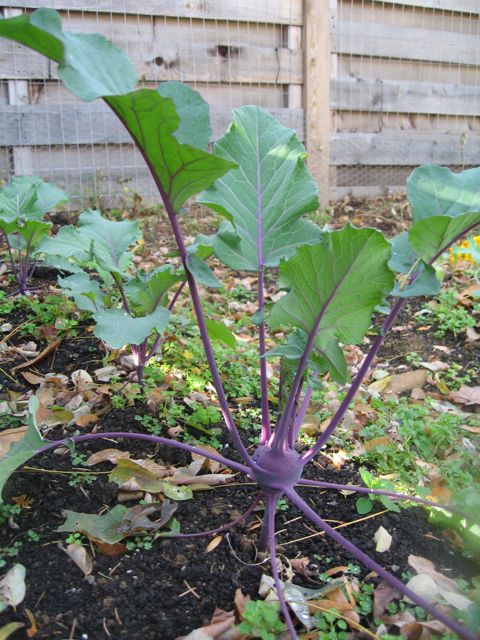
A few weeks ago I gave a lecture to some physicians and acupuncturists about the integration of food and farming in medicine.  My first slides were pictures of certain vegetables in their entirety (roots, stems and leaves) and I started the talk with a game: Let’s identify that vegetable!  The first was this series of pictures:


No one was able to identify this as kohlrabi.  An under appreciated vegetable here in this country, it is usually sold as a round light green bulb.  Rarely do people see the growing form which looks not dissimilar to a UFO.  I fell in love with this shade-tolerating vegetable after I made my first meal of kohlrabi pancakes with minted yogurt.

The second vegetable in the game:


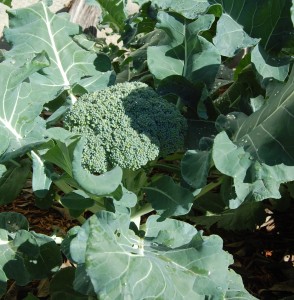
More easily identifiable, but with a little hesitation.  Everyone knows what broccoli looks like, of course, but I was stunned this summer when my brother stood at the end of a raised bed filled with broccoli and could not identify the vegetable - it was in its growing form that confused him.  The head which we eat is surrounded by multiple big waxy leaves and that’s what threw him off.

My whole point with the above lessons was that we have become so dissociated with what we eat. Such that it is to the point that items like plastic-wrapped yams are conveniently pre-wrapped so they can be easily be put in the microwave and further separate the consumer from the actual vegetable. Another disheartening example is a packaged steak which appears as nothing more than a soft red wet mass of muscle; no thought is paid that it came from anything resembling an animal and even less thought to how it was raised, fed and slaughtered.

I then showed a video of a new product called “Fruit 2 Day” a fruit containing beverage the advertiser touted as a “new way to eat fruit”. The video begins with a young girl looking disgusted at a bunch of moldy strawberries she finds in her fridge. 


The piece de resistance was in the subtle last statement of the commercial: “find it in the produce section.”  Our perceptions of what is healthy, fresh and what is REAL food is persistently and indolently being manipulated by media and advertising.  Sadly, most of us don’t know what real food is anymore and when we’re given it, we’re not sure what to do with it.  Case in point: Kale.

One physician told me that she disliked getting so much kale in her CSA basket.  How many times can you blanch and saute it with garlic and onions?  Not only was it a non-versatile vegetable for her, she couldn’t get her husband to eat it and forget about even presenting it to the kids.  I challenged that assumption and could because I was once in her shoes standing there among the abundant kale in my farm not sure how to make it interesting enough to serve it with any frequency.  But I persevered, scouring through cookbooks, recipe websites and pinning down every vegetarian I knew, asking them - “what is your favorite thing to do with kale?”  Now I am a kale convert and the last recipe I made with kale and quinoa was so simple and the kale so sweet from the frost that my better half emphatically jumped up declaring his new found love of kale.  No, not anything like Tom Cruise on Oprah’s couch, but hey, for a carnivore loving man to express delight over one of the most healthiest things you could possible eat, that made all my kale research and experimentation worthwhile.  Now he can proudly wear his “Eat More Kale” T-shirt with newfound pride. He looks hot in it as well.  Eat More Kale!

There are advantages to living in colder climates (not many for every type of food grower, I admit) and that is frost’s effects on certain vegetables, not to mention forcing us to experiment with growing cold tolerant vegetables we might otherwise avoid.   Certain things get sweeter when exposed to frost: carrots, turnips, parsnips, brussels sprouts and kale.  In an effort to survive the colder temperatures, the plant begins to convert its starches to sugars because sugar has a lower freezing point.  Carrots become like candy and kale becomes king.  That’s one thing California and Florida can’t top! 

So you’re still waiting for those kale recipes, I know.  Some of my favorites are the above-mentioned “One Pot Kale and Quinoa Pilaf” on my new favorite foodie blog Food 52.  Trust me, you can force down a lot of kale this way and people won’t even know it.  Then there’s the now ubiquitous kale chips with its infinite variations. I give credit to the first person who fed these to me, Dan Barber, in this recipe.  Kids won’t know the difference between their other starchy crunchies and these healthy bad boys.  My nephew Max, pickiest eater in the universe, can attest to that.  After Thanksgiving, using the turkey carcass, I made Alice Water’s Turkey Soup with Kale (and doubled the amount of kale).  Kale can be thrown in with many other brothy soups as well to give it a  balancing vegetable component.  But the most interesting recent recipe was recently published by the New York Times: Grilled Coconut Kale by Vij’s in Vancouver, British Columbia - one of the best Indian food meals I’ve ever had.  I served it along side curried chickpeas and basmati rice.  Heavenly. 

My hopes to you for the holiday season: find a way to get this important vegetable on your table and enjoy the way nature has changed it for you, just in time when most of our produce is no longer locally grown, so you can continue fresh local greens throughout the chill and support our local food movement.


RECIPE: GRILLED COCONUT KALE

3 bunches kale
3 cans coconut milk
1 Tbs kosher salt
1 tsp cayenne
1 tsp mild paprika
1/2 cup freshly squeezed lemon juice

1. Wash the kale thoroughly and cut out the stalks. Cut the wide leaves into strips the width of the small leaves.
2. In a large pot set over a low flame, heat the coconut milk until it is thoroughly mixed and just lukewarm. Transfer to a large, nonreactive bowl and add the remaining ingredients. Stir in the kale, cover with plastic wrap and refrigerate for at least 4 hours.

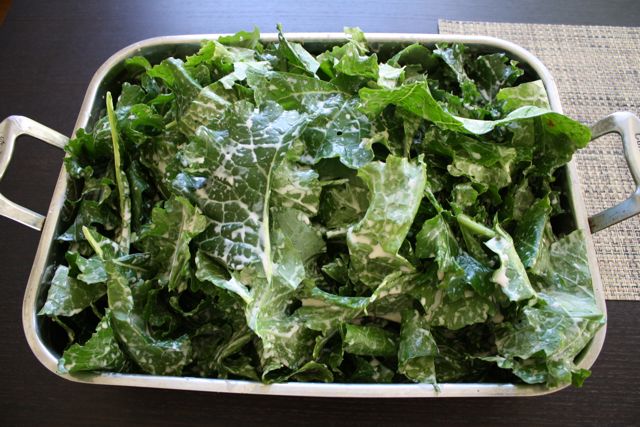
I used a large roasting pan to accommodate all the kale

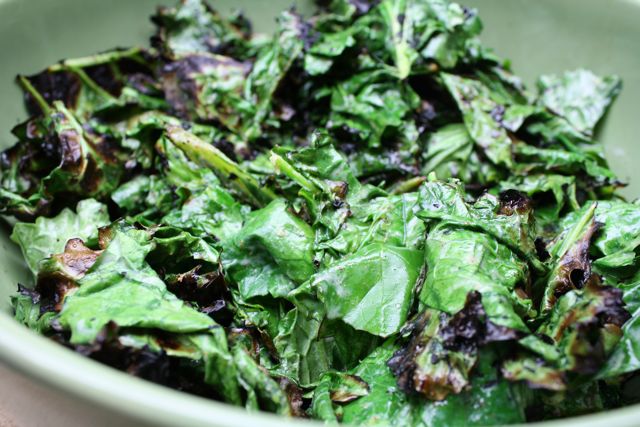
3. Preheat a grill or a cast-iron grill pan over high heat. Remove the kale from the refrigerator and stir to make sure the leaves are well covered in marinade. Using metal tongs, place the kale on the grill in a single layer. Cook for 45 to 60 seconds, or until the leaves are sizzling, then turn over and grill the other side for another 45 to 60 seconds, or until the leaves have visibly softened. Serve immediately. Serves 6.
Adapted from Vij’s Restaurant, Vancouver, British Columbia.

The slightly burned edges made the dish


Cheers to the one thing we can’t live without: Good Health


HAPPY HOLIDAYS from HOOK MOUNTAIN GROWERS!


Friday
Oct082010

Weekly Musings: Quince for Kale

Imagine everyone on your street using their land, however big or small, to grow food, whether perennial or annual, and using the food to feed each other?  “Food miles”, a term which refers to the distance food is transported from the time of its production until it reaches the consumer, would be whittled down to “food feet.”  One of the hopes of our micro-farm was to set up a model of growing to encourage others to follow our example, no matter how small their growing space or how much growing experience they had.  Our neighbors, Bob and Enid, who we met at various functions promoting the sustainable food movement, recently gave us 5 lbs of quince fruit from their tree.  We happily gave Bob and Enid a share of our abundant kale and end of season tomatoes.

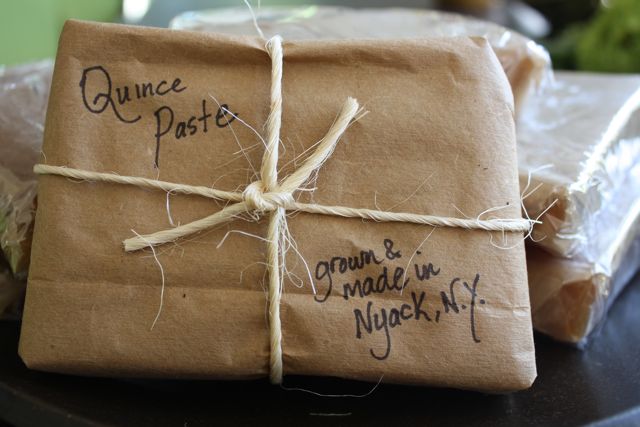
We are in the process of planning and planting various perennial trees and shrubs to provide us with fruit, berries and nuts on the section of our property we fondly refer to as our future edible forest garden.  Many of these will take years to grow and produce and we were thankful for a local supply of fruit - one we had not really cooked with before.  We had purchased and eaten quince paste, also known as Membrillo, a few years ago, which we served with a plate of pungent cheese. We found the quince paste to be an outstanding sweet accompaniment.


QUINCE
Cydonia Oblonga

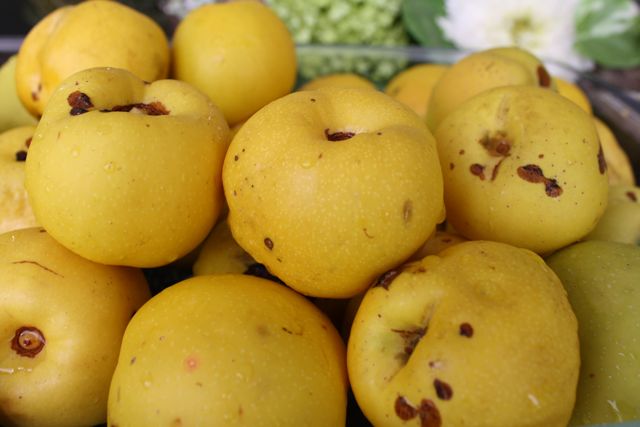
The quince fruit is highly fragrant and smells of apples and pears with the presence of floral notes as well.  When I first took notice of it, I immediately wanted to eat it raw.  Well, it was inedible.  Quince is usually not enjoyed fresh because it is highly tart and astringent.  It needs to be cooked.  The fruit is typically harvested in the fall and a mature tree can yield 75 lbs of fruit.  Though the country of Turkey ranks highest in the  production of quince fruit, it is a pretty hardy tree and can be grown in zones 5-9 in this country.  According to Lee Reich, the Hudson Valley guru of edible landscaping, in the spring “branches are festooned with large white or pinkish blossoms, each resembling a “single” rose blossom...in the late summer and autumn, the show is quite dramatic from the large yellow fruits, which can be left dangling on the stems for many weeks.” 

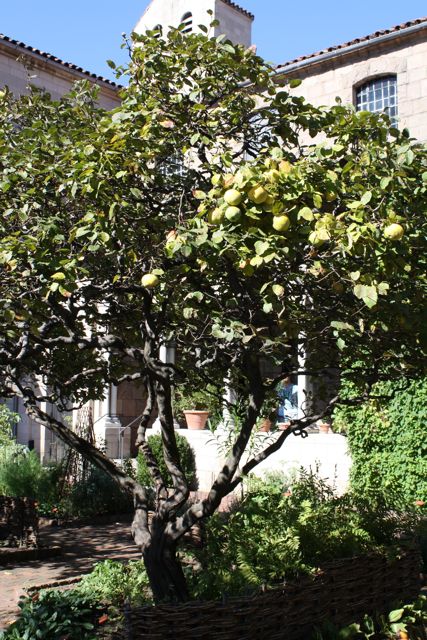
GROWING QUINCEQuince tree at the Bonnefont Herb garden at The Cloisters in Fort Tryon Park

Quince is a relatively compact tree growing rarely more than 10 feet high and two-thirds that width.  It can have multiple trunks but if you train it to have one trunk, it can take on a gnarled, twisted and picturesque appearance.  The best example can be seen in NYC at The Cloisters in Fort Tryon Park where four famous quince trees grow at the periphery of four beds that make up the Bonnefont Cloisters Herb Garden containing over 250 species of medieval medicinal herbs.

Plant quince trees in full sun and well drained soil.  Decide whether you want to have it grown as a shrub or with 1 to 3 trunks during its first growing season and prune accordingly.  If you are in the Hudson Valley, Micosta Nursery in Hudson, New York sells 6 different varieties.  You need only one tree as quince is self-fruitful.  Raintree nursery is also a good source for the west coast. 

RECIPE: QUINCE PASTE

Quince paste is a wonderful homemade gift for your foodie friends and family.  It is time consuming and should be given to those who appreciate the effort.  Since it stores well in the refrigerator for up to 3 months, it’s a great idea to make several batches to eat through the winter months and to give out as holiday gifts.  When cooking, enjoy the aromas of banana, flowers, apples and almonds that waft from the stove.  The essential tools to make this recipe are a food mill, food processor, rubber spatula, wax paper and a 9x12 roasting pan.


4-5 lbs of quince, scrubbed clean
sugar
water


Preheat oven to 350 degrees and line pan with wax paper

Place whole quince in pan, cover with foil and bake for 2 hours.  When quince is cool enough to handle, remove as much of the flesh as possible into a large food processor taking care not to put in seeds, core or any hardened, brown areas.  This is the time consuming and messy part.

Add enough water, 1/4 cup at a time to make a puree the consistency of a thin pudding.  Use the smallest disk on your food mill and process the entire batch.

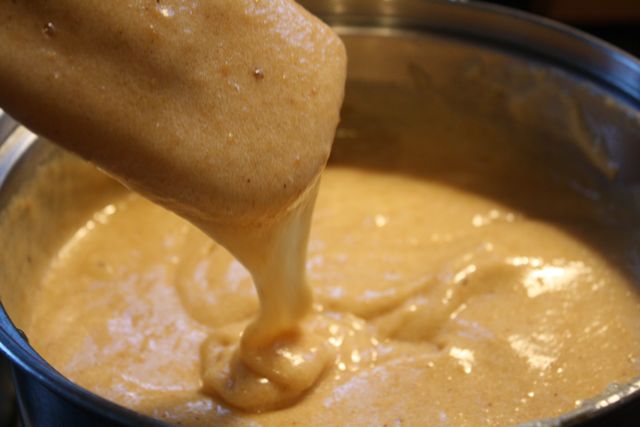
Measure out how much puree you’ve made and multiple by 2/3.  Measure out that amount of sugar.  Put puree in a heavy saucepan on med-low heat and add sugar.  For example, I made 6 cups of puree and added 4 cups of sugar.  Stir constantly for 25 minutes.  Puree will darken in color.  Be careful not to burn your puree.

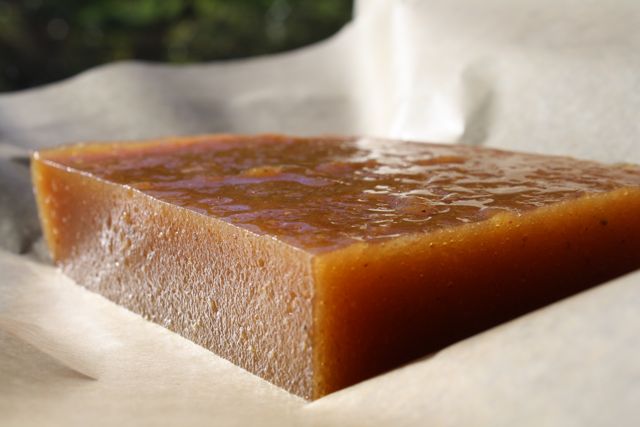
Pour into your wax-lined pan, cool then cover with plastic and chill overnight.  With a knife and spatula section off slices of your paste.  It should have a jelly and gum drop consistence.  Wrap in wax paper store and plastic and store in an airtight contained in the refrigerator.

Serve with pungent cheeses like Manchego or use as a substitute for your usual jam.


Stirring quince and sugar mixture constantlyQuince paste should have the consistency between jelly and gum dropsYeah, I had a little Martha Stewart in me when I did this.

Monday
Sep272010

Another Day in Foodie Paradise: Hudson Valley Garlic Festival 2010


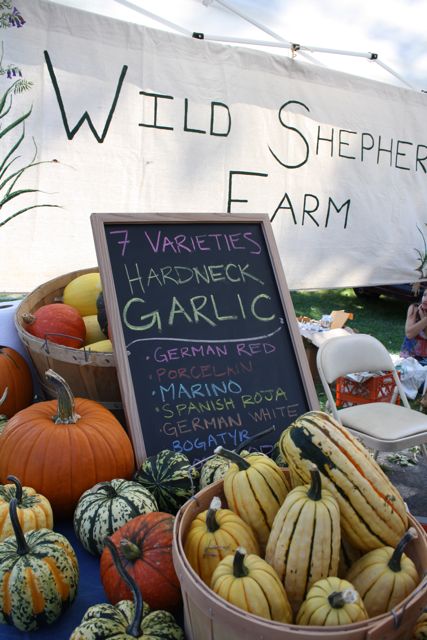
Fog and Thistle Farm in Germantown, New YorkWhen pondering what you should grow in the fall, there is one clear answer: Garlic.  Easy to grow and rewarding, this allium is a powerful player in achieving optimum health.  There are many websites with great instructions on growing, maintaining, harvesting and storing garlic.  Take 1 clove of garlic and place in the ground in October (in Zone 6 New York), pointy side up, 2” deep and 6” apart.  Cover with seed free mulch and wait patiently until the spring.  You’ll first enjoy eating the garlic scapes in June and then finally the bulbs in mid-summer and on.    You do NOT want to use garlic for planting from your regular grocery since it is likely sprayed with a substance to prevent sprouting, according to Witchcat Farms in Vermont.  Buy directly from the farmer.  We met the nice people at Witchcat Farm at the Hudson Valley Garlic Festival in Saugerties, New York.  This was the 22nd year of the festival and runs at the end of the month every September.  We loaded up on 2 organic varieties from Witchcat Farm: German Porcelain Music, 4-5 large cloves per head and mild in taste and the more unusual Hungarian Purple, with 6-8 cloves and more spicy and pungent in flavor.


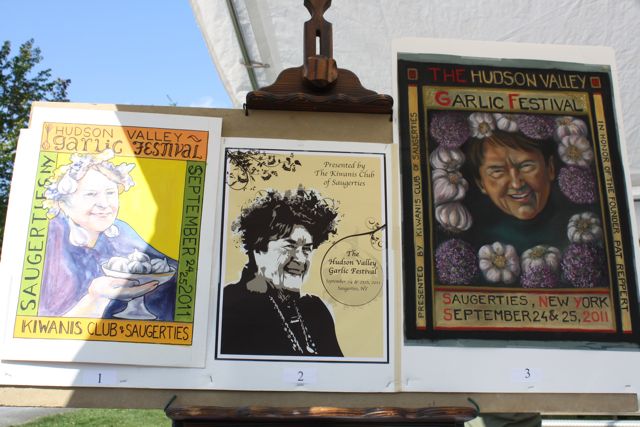
Possible posters for the next garlic festival in 2011
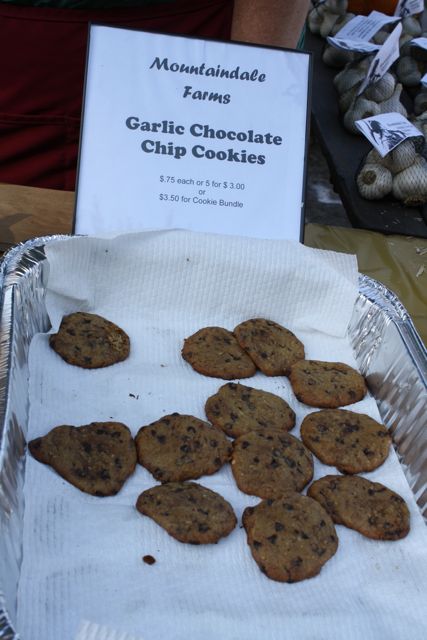
The Hudson Valley Garlic Festival is one of over 50 garlic festivals in the country.  There is everything garlic you can imagine.  Garlic Hamburgers, Garlic Ice Cream, and Garlic Chocolate Chip cookies that we snatched up from Mountaindale Farm.

Soft, gooey and so right after a garlic heavy meal

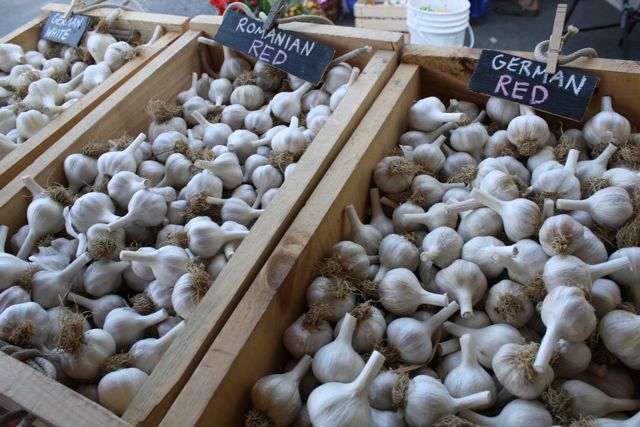
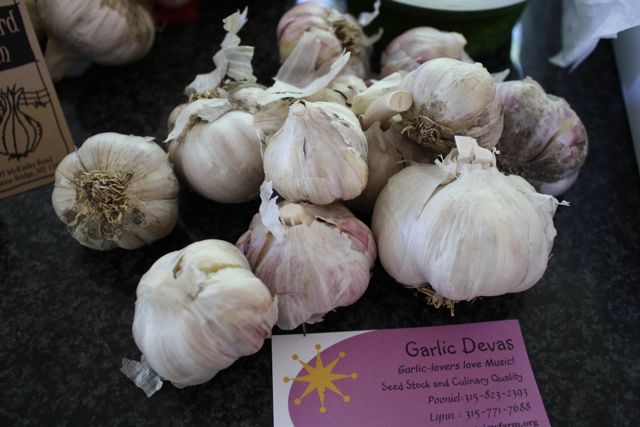
Over 45 garlic farms, mostly from New York State, set up gorgeous booths selling their incredible bounty.  The other varieties we purchased were Spanish Rojas from Free Bird Farm, German Reds from Six Circles Farm, and Riesig from Cedarville Farm.  We were especially excited about a rare variety called MarJean from The Garlic Devas in Lewis County New York.  This garlic, with no official name, has been grown for generations in New York by Marty and Jean, neighbors of The Garlic Devas, thus the name, MarJean garlic.  Marty and Jean are now in their mid 80’s and happy to see their garlic live on with The Garlic Devas.  We are definitely planting lots of this variety and will continue Marty and Jean’s work.


We already harvested 200 garlic heads this July on our farm but we have to find the balance between how much we personally consume and how much we sell to become sustainable i.e. not having to buy more garlic to seed every season.  This season we plan on upping the ante and planting at least 400 cloves.


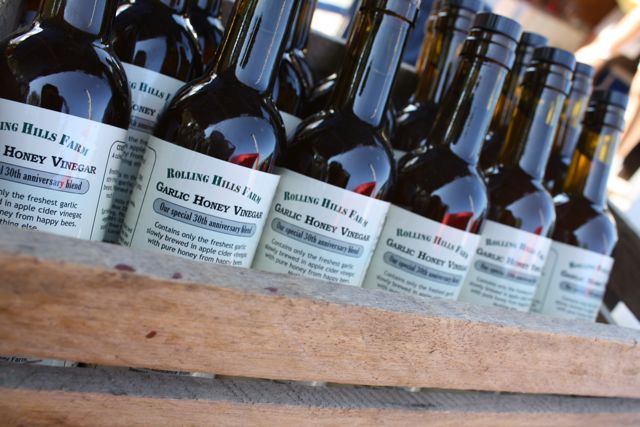
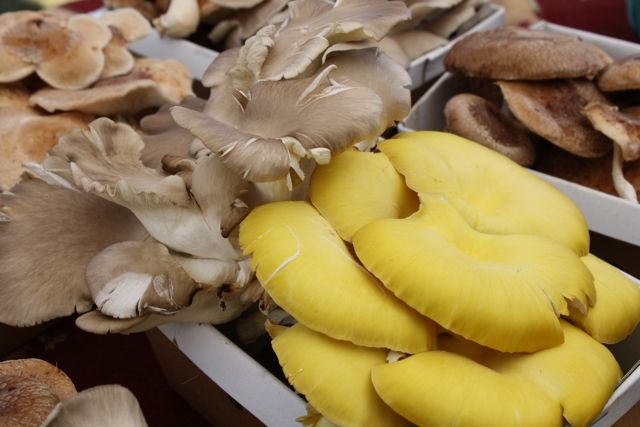
In addition to garlic, there was honey which  we bought from Swarmbustin Honey, Maple Syrup from Mapleland Farms, Garlic Vinegar from Rolling Hills.  This garlic vinegar is indispensible in our salad dressingsGorgeous yellow oyster mushrooms from Wiltbank Farm in the Catskills, venison and buffalo products from Highland Deer Farm (the Buffalo steak was divine!).  Why deer need to be farmed in this area is an enigma!


Yellow and brown oyster and shiitake mushrooms are Wiltbank Farm's specialty
We stopped and spoke with David Stern current Director, writer, lecturer, horticulturist and cofounder of the Garlic Seed Foundation, an educational not-for-profit organization that promotes ecological production and hearty consumption of garlic.  I asked him why, in New York State when we have a plethora of garlic farms, does grocery Visit the Garlic Seed Foundation store garlic come from China or Argentina (even Whole Foods).  His simple answer, as a farmer himself was, “Why would I sell my garlic cheap when I can make a better wage selling garlic locally at farmers markets and at garlic festivals like this one?”  Good answer.  Whole Foods and other grocers want to pay the lowest price for a product so as to maximize profits.  Garlic farmers are smart and know where their markets are.  We should all consider this when purchasing garlic for ourselves and our families. By paying a bit more for local garlic we support the farmers who work hard to grow the garlic, we ensure a local source of organic garlic and most importantly we keep the farms of our local garlic growers economically viable and able to stay in business.  For more information on garlic, visit the Garlic Seed Foundation website and become a member.  Once you do you have access to the garlic hotline - someone will answer all your questions on garlic!  We joined and are looking forward to our first issue of The Garlic Press.


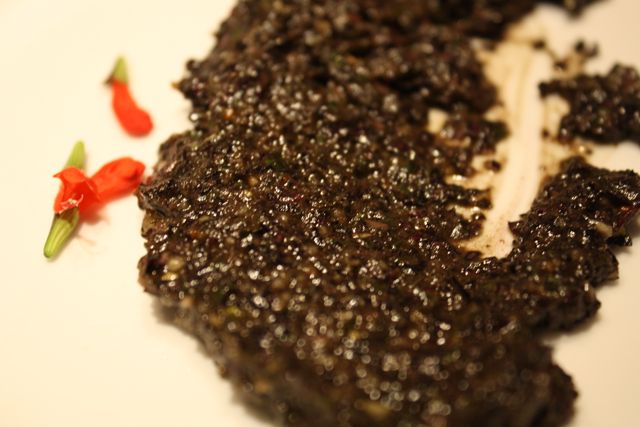
In honoring garlic in a recipe, something I love to do in so many ways, I decided to feature a Purple Basil Pesto.  I grow a basil that tastes like a Genovese Italian Basil but with deep hues of purple.  The resulting pesto turns out to be more black than purple but can be a gorgeous counterpoint in pasta or bread if topped with a chiffonade of green basil.  Out of the various pesto recipes I've tried, this is the one I go back to everytime.  It's so good, you could even leave out the cheese making this dairy-free and won't feel deprived.

RECIPE: BASIL PESTO

2 garlic cloves
Salt
3 Tbs toasted pine nuts
3 cups basil leaves, stems removed
1/4 cup grated parmesan
1/2 cup extra virgin olive oil

In a food processor, process garlic, salt and pine nuts first.  Then add basil and olive oil.  When smooth add parmesan just to combine.  If freezing, do not add parmesan until you defrost and use it in the future.

Adapted from Deborah Madison


Friday
Sep242010

Eggplant vs. Flea Beetle: Viva La Aubergine

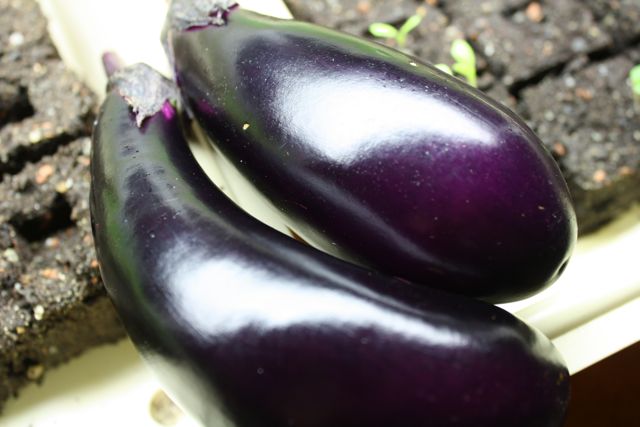
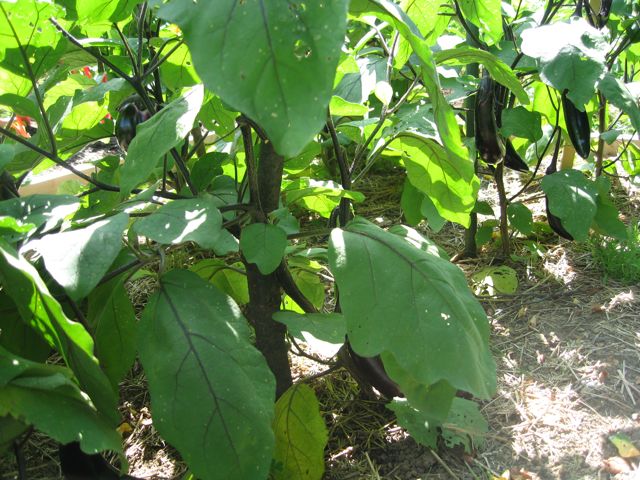
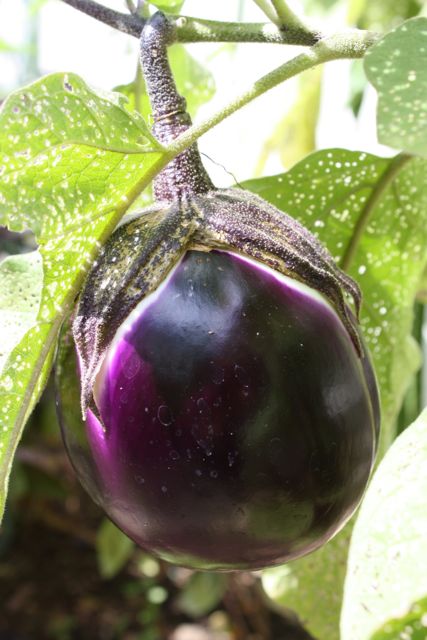
It’s Fall.  For most people who grow, this is the last stretch for the heat-loving plants such as tomatoes, peppers and eggplant.  At this point, I think I’ve eaten enough fresh tomatoes to last me through the winter.  One thing I haven’t grown tired of are eggplants.  I never thought too much of them until I grew them and was forced to find creative ways to cook them; now I’m an addict.  We grew a few different eggplants here but my favorites are a Japanese and Tuscan variety.  The Japanese come in early and continue to produce and the Tuscan Globe comes in later in the summer and are prolific with heavy, strikingly violaceous fruits.

The biggest issue in growing eggplants are keeping flea beetles from making swiss cheese from the leaves.  This annoying poppy seed-sized pest shows up early in the season and continues to eat away the leaves of the eggplant.  I am surprised that eggplant is not considered one of the “dirty dozen” fruits - the vegetables that contain the highest levels of pesticides even after being washed and peeled.  The list, compiled by the Environmental Working Group (EWG), lists celery, kale, and bell peppers as among the most contaminated.  Obviously, with organic growing techniques this is not an issue.  

Part of our organic practices to reduce pests and disease is to use Nutrient Density growing techniques that address the quality and health of the soil which will then translate to a healthier plant.  The same reason a strong healthy immune system is integral to a healthy human being, the same logic applies for the plant.  Last year our eggplants had flea beetles but the plants were so strong that they could still grow lush and produce a nice bounty of fruit in spite of the bugs.  This year, the flea beetles became more of a nuisance and the plants were not able to compete with them.  They did not succumb to the bugs but they were certainly not the optimum and productive plants we saw last year.  Click HERE  to see an example of plant stress and evidence of how a strong plant is your best defense against disease and pests.  Please note how the plants at the left of the bed received optimal light and are healthy and pest free and how the plants towards the right were partially shaded and have evidence of insect damage to the leaf.  The Nutrient Density growing method can take 3-4 years to really change the mineral and microbial content of the soil so we didn’t expect to see a dramatic change right away.  Every season, we re-test soil and re-amend the soil and much of the amendments take seasons to break down to be utilized by plants and soil microbes.  So what did we do besides watch the flea beetles have a hey day?

CONTROLLING FLEA BEETLES - ORGANICALLY

In the long term, addressing the soil health should obviate the need for “control” but in the meantime, I’m not going to sit around letting a little army of flea beetles dine on my eggplant.

1. Crop rotation.  This is essential since the adults can overwinter in the soil and in plant debris.   However, if your area is small, you are likely not able to plant them far enough from last season’s planting area. They emerge in the spring waiting for you to put your healthy seedlings in the ground.  If your seedlings are stressed they will take this opportunity to defoliate and kill your plant.  You definitely want the healthiest seedling possible and you don’t want to plant these seedlings too early since eggplants LOVE heat.  Using a row-cover in the spring until the population of flea beetles die down is also helpful.  It’s just a physical barrier between the plant and the environment.

2. Trap Crops - this is more applicable to farms, but the idea is to plant a more desirable plant for the flea beetles to feed on so they leave the eggplant alone.  This includes planting Chinese mustard greens nearby or to interplant radishes like “Chinese daikon” or “Snow Belle.”

3. Manual Removal - There are reports that physically removing beetles can be effective.  The flea beetle is so small that some people report using a small portable vacuum to literally just suck them off the plants.  We have not tried it but plan on doing it next year if continues to be a problem.  Time to find the old Dust Buster.

4. Botanical controls - the last option.  The only one that we would advise using is a very diluted spray of organic neem oil  Apply this only on a cloudy day.

Tuscan "Prosperosa" Eggplant. Note the leaves.

COOKING WITH EGGPLANT

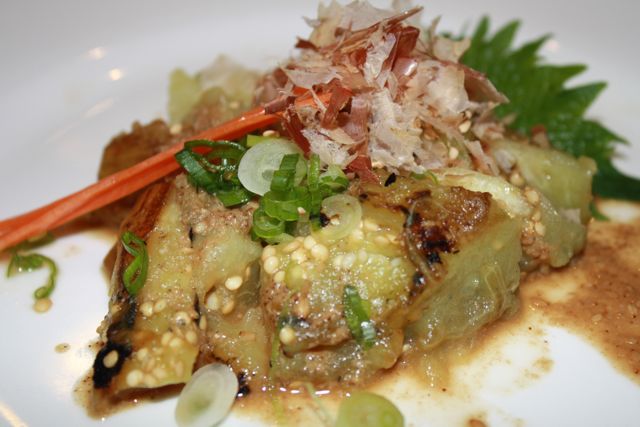
A few of our favorites dishes that use eggplant include a Baba Ganoush, Roasted Vietnamese Eggplant with Scallion Oil, breading and frying the slices of eggplant, grilling slices, and using them in stir-fry dishes.  When laziness creeps in, we bring our Japanese eggplant to our local sushi master, Ume, at Murasaki in Nyack, New York.  The first time we did this, Ume looked at the eggplant thoughtfully, brought them back to the kitchen to broil and minutes later presented us with a simple dish from his childhood in Japan.  How cool is that?  Here’s the recipe he used.  It’s simple and sublime.  It is so refreshing to find a chef that is so excited by the challenge of using local ingredients on the spot.  Murasaki has become one of our favorite restaurants in town and we high recommend it to anyone who enjoys traditional artisanal sushi.


RECIPE: Yaki Nasu (Ume’s Eggplant)

4 Japanese Eggplant
3 Tbs sesame paste
1 Tbs soy sauce
1 Tbs brown sugar
2 Tbs Dashi (this is a bonito and seaweed broth).  You can substitute with dashi powder which is sold in Asian markets.
garnish with 2 Tbs bonito flakes and/or thinly sliced scallions (optional)

Broil eggplant until soft (5-10 minutes).  Peel off skin and cut into sections
Blend the remaining ingredients together
Spoon sauce over eggplant and garnish with bonito flakes and scallions